
The first time a rocket came back
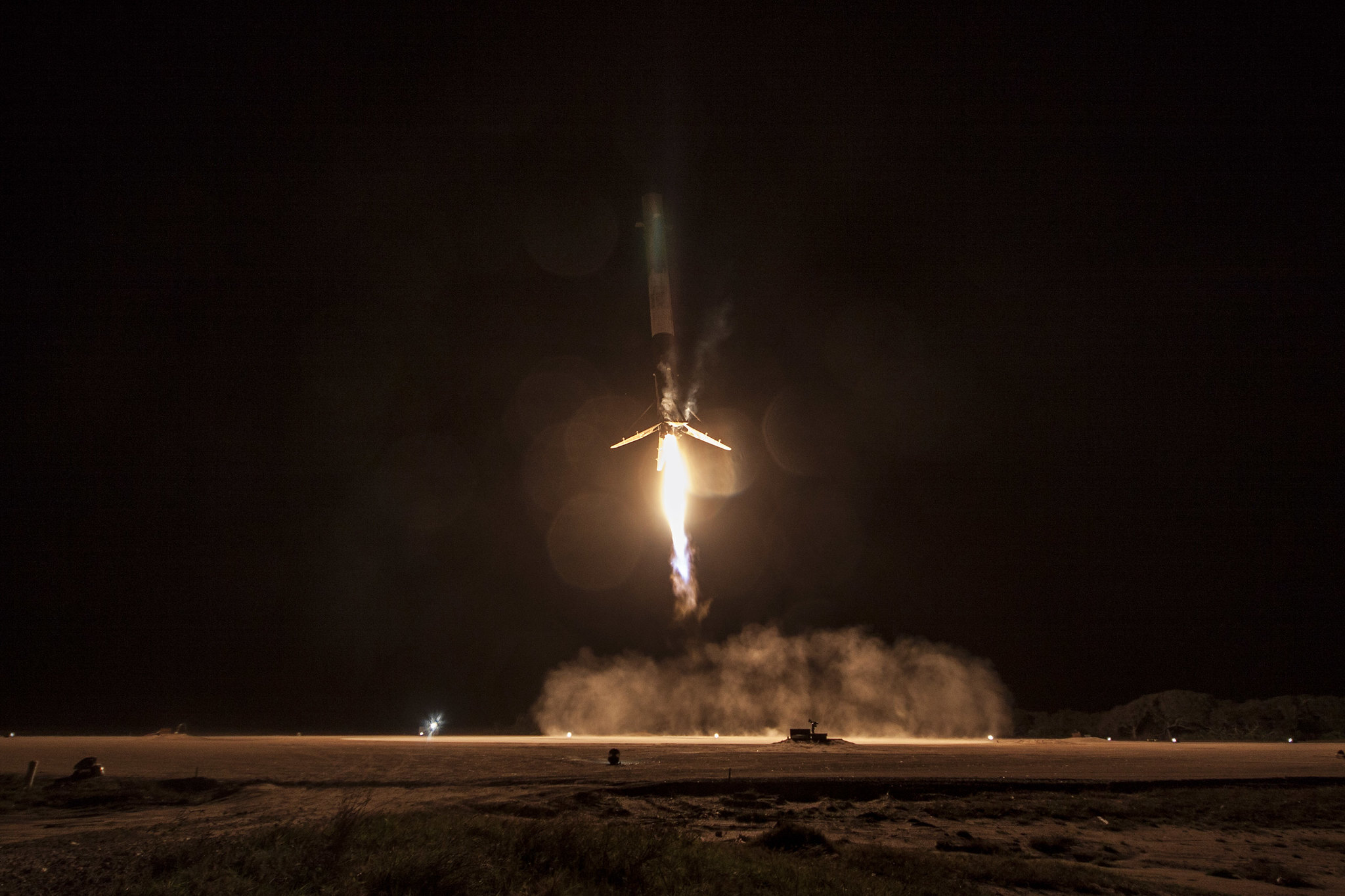
On 18 April 2014, SpaceX attempted something no company had done before. During its third contracted cargo run to the International Space Station for NASA, the Hawthorne, California company flew a Falcon 9 rocket fitted with landing legs, and after the Dragon capsule was on its way to the station, it guided the rocket's boost stage back down for a controlled, vertical descent into the Atlantic Ocean. Despite rough weather, the stage touched the water upright before stormy seas later broke it apart. SpaceX had given the attempt less than even odds of working.
A week later, at a news conference at the National Press Club in Washington, the company's founder Elon Musk framed the result in deliberately measured terms.
"No one has ever soft landed a liquid rocket boost stage before, and I think this bodes very well for achieving reusability. What SpaceX has done so far is evolutionary, but not revolutionary, and I think if we can recover the stage intact and re-launch it, the potential is there for a truly revolutionary impact in space transport costs."
An engineering test that doubled as a story
The economics behind the attempt were easy to state. Musk noted that propellant accounted for roughly 0.3 percent of the cost of an approximately $60 million mission, which meant that recovering and reflying the hardware could, in principle, cut launch costs by a factor of 100. The company expected to keep refining its landings through the rest of the year, to bring a stage down at Cape Canaveral by the end of 2014, and to refly a booster in 2015.
For a brand, the more telling detail was that the test was visible. SpaceX captured video of the descent and announced that it would release the footage once it had been cleaned up, even inviting members of the public to help process the grainy recording. That decision said as much about the company's approach to its audience as the landing said about its engineering. A private firm was treating a difficult, uncertain test not as an internal milestone to be reported afterward, but as a shared event the public was asked to take part in. Musk also underlined how long the company had pursued the goal, noting that it had taken 12 years to reach this point, a reminder that the reusable rocket was a founding ambition rather than a late addition to the programme.
Reusability as a brand idea
SpaceX has never run conventional advertising. It built its public profile through the launches it staged, the streams it produced and the imagery it released, and the 2014 soft landing was an early proof point for the single idea that would come to define that profile. Established launch providers treated rockets as expendable, used once and discarded. SpaceX set out to make the returning, reusable rocket its signature, and the sight of a booster descending tail-first would become the most recognisable image the company ever owned.
Musk's choice of words mattered here too. By calling the achievement evolutionary but not revolutionary, he set a narrative in motion rather than declaring it finished. The framing invited audiences to follow the company toward a future payoff, the moment a recovered stage would fly again, and it turned a sequence of test flights into an unfolding story with a clearly stated goal. That is closer to how a brand builds anticipation for a campaign than to how an aerospace contractor reports a test.
The image the company would build on
The 2014 stage did not survive, and the first successful landing on solid ground was still more than a year away. The attempt nonetheless established the template. Reusability gave SpaceX a concrete, repeatable spectacle, a thing that either worked or did not in full public view, and it gave the brand a proposition that ordinary audiences could grasp without any background in spaceflight. The promise was simple to follow: rockets that come back, and launches that cost far less because of it.
In the years that followed, the company turned that promise into routine, landing boosters on land and on autonomous ships at sea and broadcasting each attempt to a large and committed audience. The first soft landing in the Atlantic was where that approach began to take shape. It showed that SpaceX intended to compete not only on the cost and capability of its rockets, but on the visibility of what they did, and it pointed to a way of building a brand out of engineering itself rather than out of advertising.
Source: SpaceX Youtube
Written with AI assistance, edited by a human. Find out more about our Use of AI.