
Twenty out of twenty-one
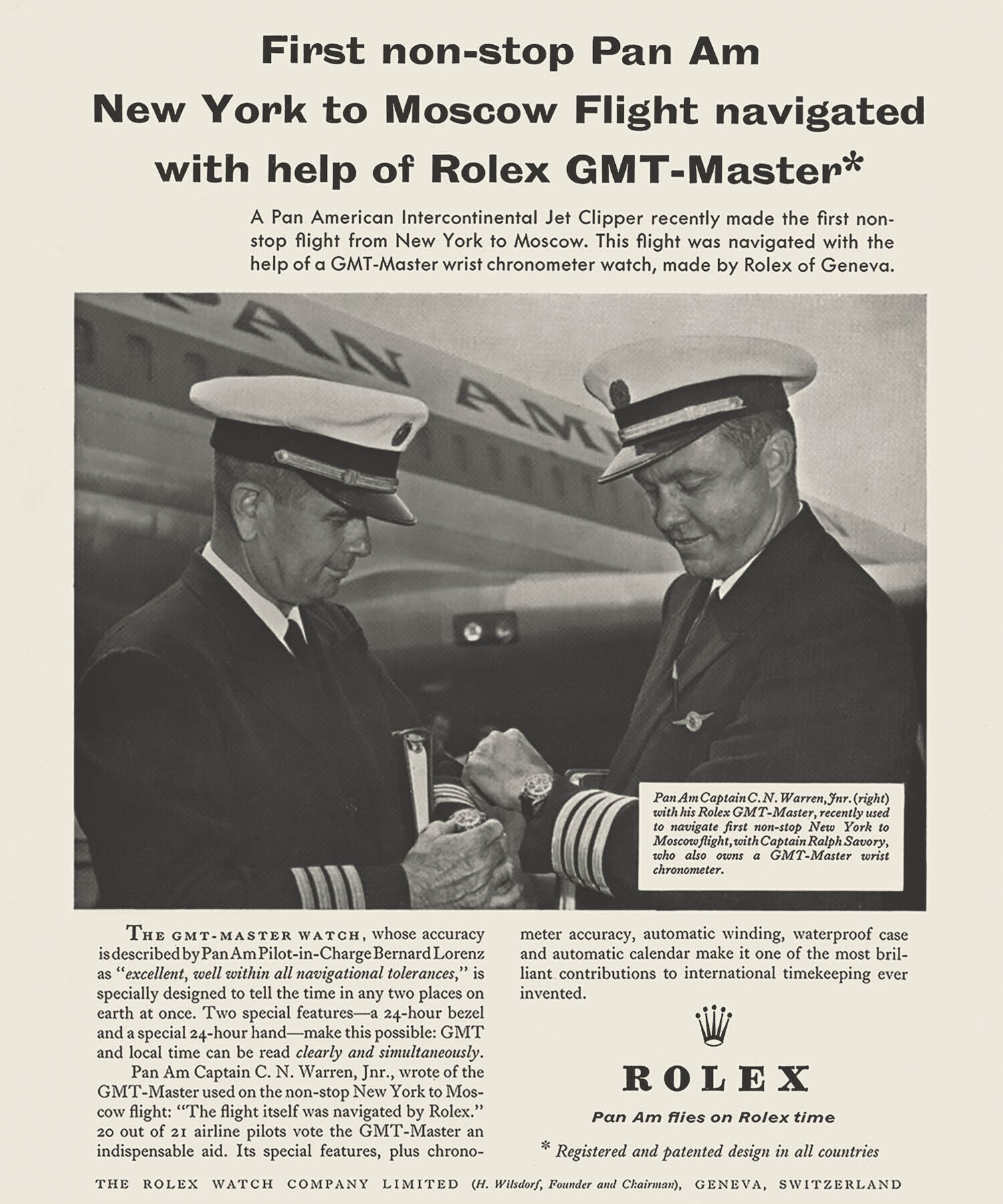
Halfway down the second column of body copy, between a description of the 24-hour bezel and a list of case features, the advertisement states a number: "20 out of 21 airline pilots vote the GMT-Master an indispensable aid."1
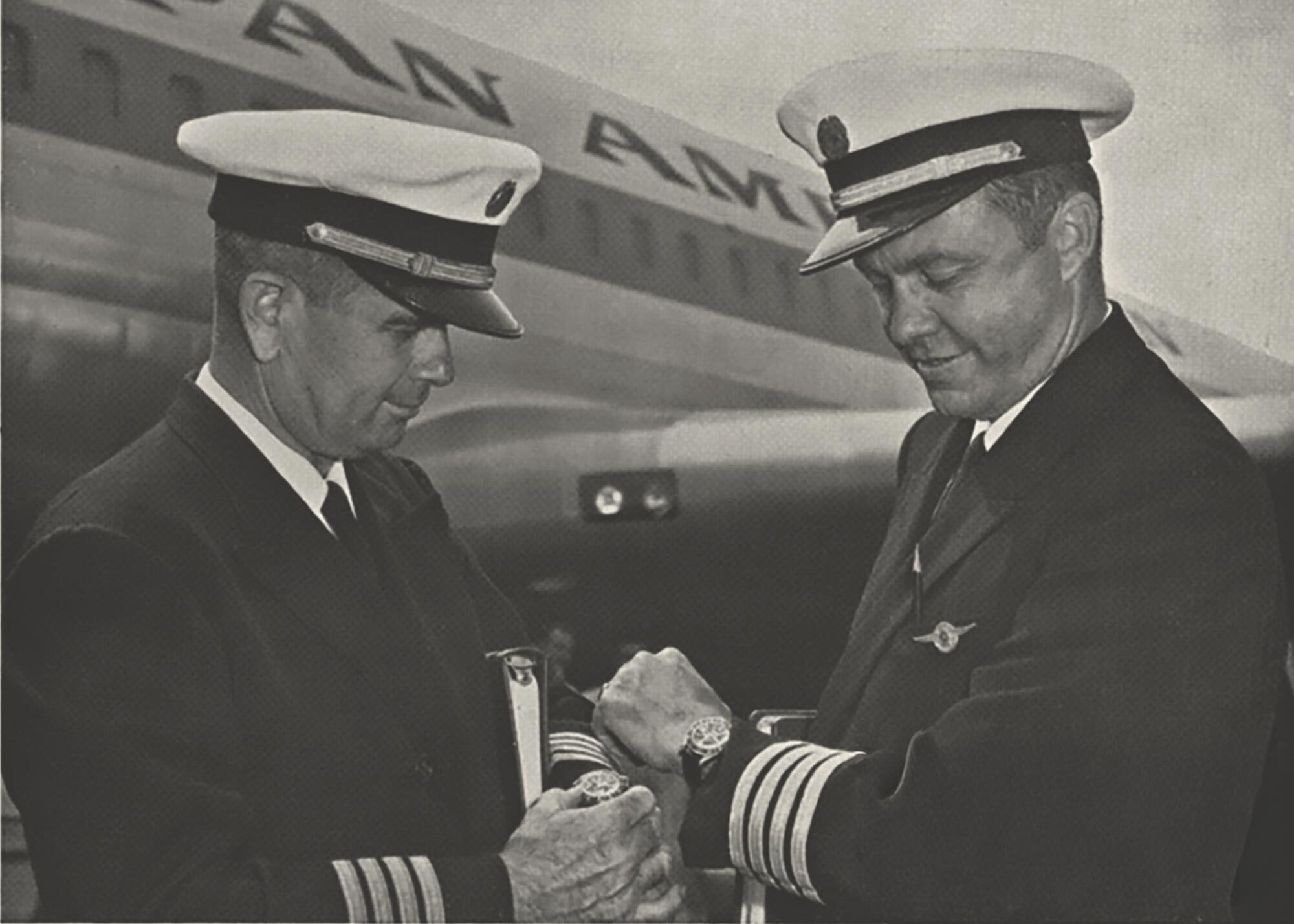
The sentence does not say who asked, when, where, or how the twenty-one were selected. It does not name a research house or a date. It is a poll result with no poll attached, printed in an advertisement for a Swiss chronometer among photographs of two uniformed captains in front of a Pan American jet.1
What the fraction is doing
The form of the sentence is not the form of a luxury advertisement. A counted majority of qualified professionals, expressed as a near-unanimous fraction and attributed to no source, is the grammar of household goods. Rolex applies it to a watch sold at the top of its category.
What it buys is a change of evidentiary class. A captain's letter is an anecdote, and readers know how anecdotes are obtained. Twenty out of twenty-one is a census, or reads like one: it converts one man's opinion into a profession's verdict, and it implies a population that was asked and counted. The device does not have to survive scrutiny to work. It has to survive the reading.
The single dissenting pilot is the part that does the most work. A round twenty-one out of twenty-one would read as a claim. One holdout reads as a measurement.
Three named men and a counted population
The rest of the page stacks witnesses of a different type on top of it. Pan Am Pilot-in-Charge Bernard Lorenz is quoted on accuracy, calling it "excellent, well within all navigational tolerances". Captain C. N. Warren, Jnr., pictured with his own GMT-Master, is quoted in writing on the New York to Moscow flight: "The flight itself was navigated by Rolex." A caption names a third, Captain Ralph Savory, who also owns one.1
So the page offers a hierarchy: an executive who vouches for the specification, a captain who vouches for a specific flight, a colleague who vouches by ownership, and a counted body of the profession that vouches for the category. Each type covers a weakness in the others. The poll is the only one that claims to speak for everybody.
Why the claim had to be this strong
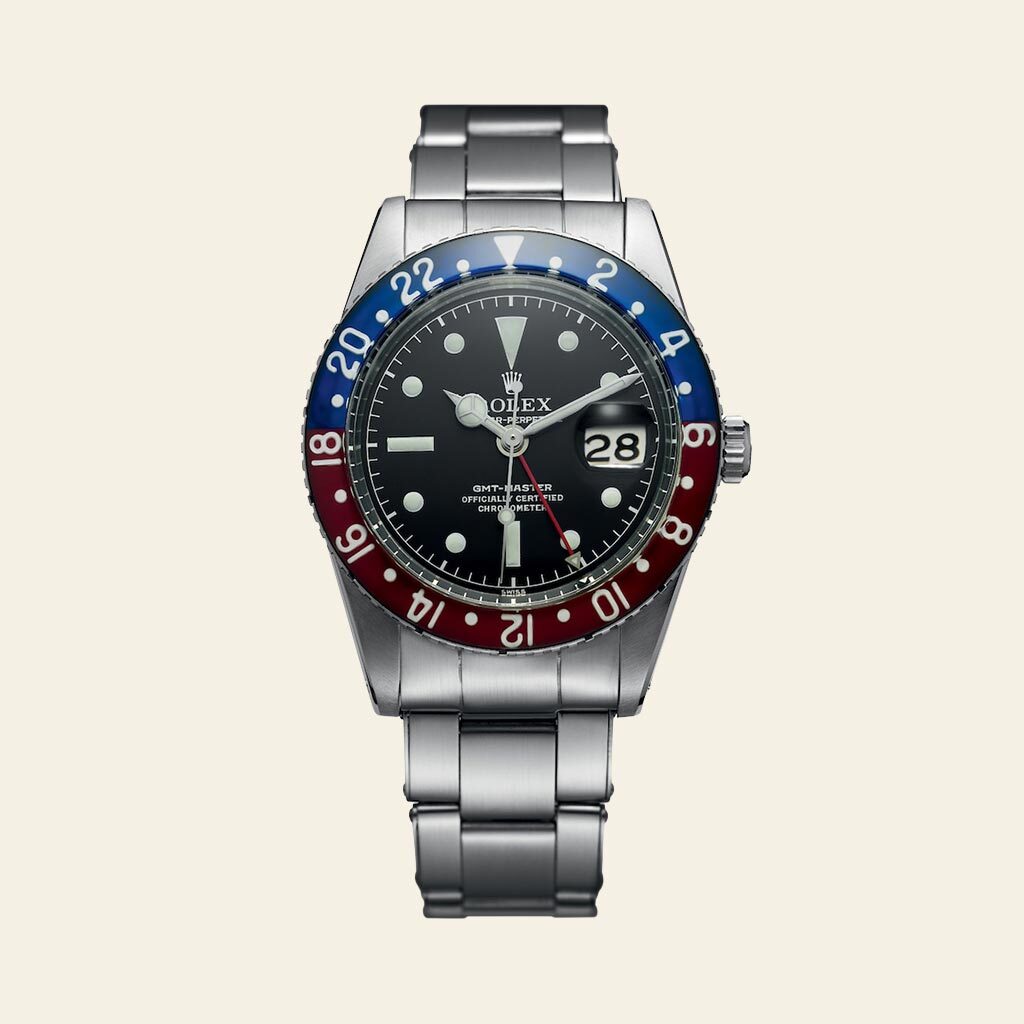
The GMT-Master had a problem that the Oyster and the Explorer did not. Waterproofing can be demonstrated: a swimmer crosses a channel, a watch comes up dry. A second time zone cannot be dramatised at all. The watch was designed, in Rolex's own account, as a navigation aid for professionals crossing time zones, with a 24-hour bezel and a 24-hour hand so that home time and local time could be read at once.2 That is a convenience, and a convenience does not photograph.
The advertisement solves it by relocating the proof from the object to the profession. It cannot show the watch working, so it shows the people who use it agreeing that it works, and then counts them. Under the crown at the foot of the page the line reads "Pan Am flies on Rolex time", which is the same move at brand level: a supplier making a claim about its customer's operations.1
Who the count is for
Almost nobody reading the page was going to navigate anything. The GMT-Master was sold at the top of the market to people who flew as passengers, and the pilots in the photograph are not the buyers. They are the credential.
That is what the counted majority delivers and a single endorsement cannot. A famous name attached to a product tells the buyer that someone glamorous was paid. A profession's near-unanimous verdict tells the buyer that the object is correct, and correctness is transferable in a way glamour is not: the passenger who buys the watch the working crew is said to rely on acquires a piece of the cockpit rather than a piece of the celebrity. Rolex spent the following decades building that transfer into the product names themselves, and the poll is an early, blunt version of the same argument.
What the device left behind
Rolex went on to make the GMT-Master the official watch of several airlines, Pan Am among them, and the airline association outlived the airline.2 The counted-pilots sentence did not survive into the brand's later voice, which certifies its own watches against criteria it writes itself and publishes no third-party tallies at all. In 1959 the credibility had to be borrowed from the people in the cockpit. The modern Rolex argument is that it can be manufactured in Geneva.
Written with AI assistance, edited by a human. Find out more about our Use of AI.
1. Rolex, GMT-Master advertisement headed "First non-stop Pan Am New York to Moscow Flight navigated with help of Rolex GMT-Master", reproduced in Chapter, "The most iconic Rolex vintage ads from the last 100 years", Repro Edition 8, text by Lejla Avdic, first published in Chapter No. XI, winter 2024/25, read 22 September 2026, for the headline and standfirst, the photograph of two Pan American captains, the caption naming Pan Am Captain C. N. Warren, Jnr. and Captain Ralph Savory, the quotation from Pan Am Pilot-in-Charge Bernard Lorenz, the written quotation from Captain Warren, the sentence "20 out of 21 airline pilots vote the GMT-Master an indispensable aid", the description of the 24-hour bezel and 24-hour hand, the line "Pan Am flies on Rolex time" beneath the crown, and the imprint of The Rolex Watch Company Limited with H. Wilsdorf as founder and chairman. The advertisement names no research house, no date and no method for the pilot figure. Chapter is a design magazine and is not on the journal's source whitelist; it is cited as the publisher of the reproduced artwork, not as an authority on the facts. https://chapter.digital/en/watches-rolex-vintage-ads/
2. Rolex, "Rolex History, 1953 to 1967", retrieved 22 September 2026, for the GMT-Master of 1955 designed as a navigation aid for professionals crossing time zones, for its two-tone bezel marking daytime from night-time hours, and for its becoming the official watch of several airlines including Pan American World Airways. https://www.rolex.com/en-us/about-rolex/history/1953-1967