The product name and the name that stuck
The watch Rolex launched in 1963 was called the Cosmograph. Rolex describes it as reference 6239, a chronograph built for endurance racing drivers, robust and waterproof, with a tachymetric scale on the bezel for calculating average speed.1 Nothing in that name refers to a place, a race or a sport. Cosmograph is the name of an instrument.
The name it carries today is Daytona, and Daytona is not a product idea. It is a city in Florida, a stretch of beach, and from 1959 a speedway Rolex had partnered since that year.2 A watch company took the name of a property in its sponsorship portfolio and put it on a product, and the product name it had chosen itself did not survive the encounter
Source: Rolex Youtube
What Rolex was already attached to
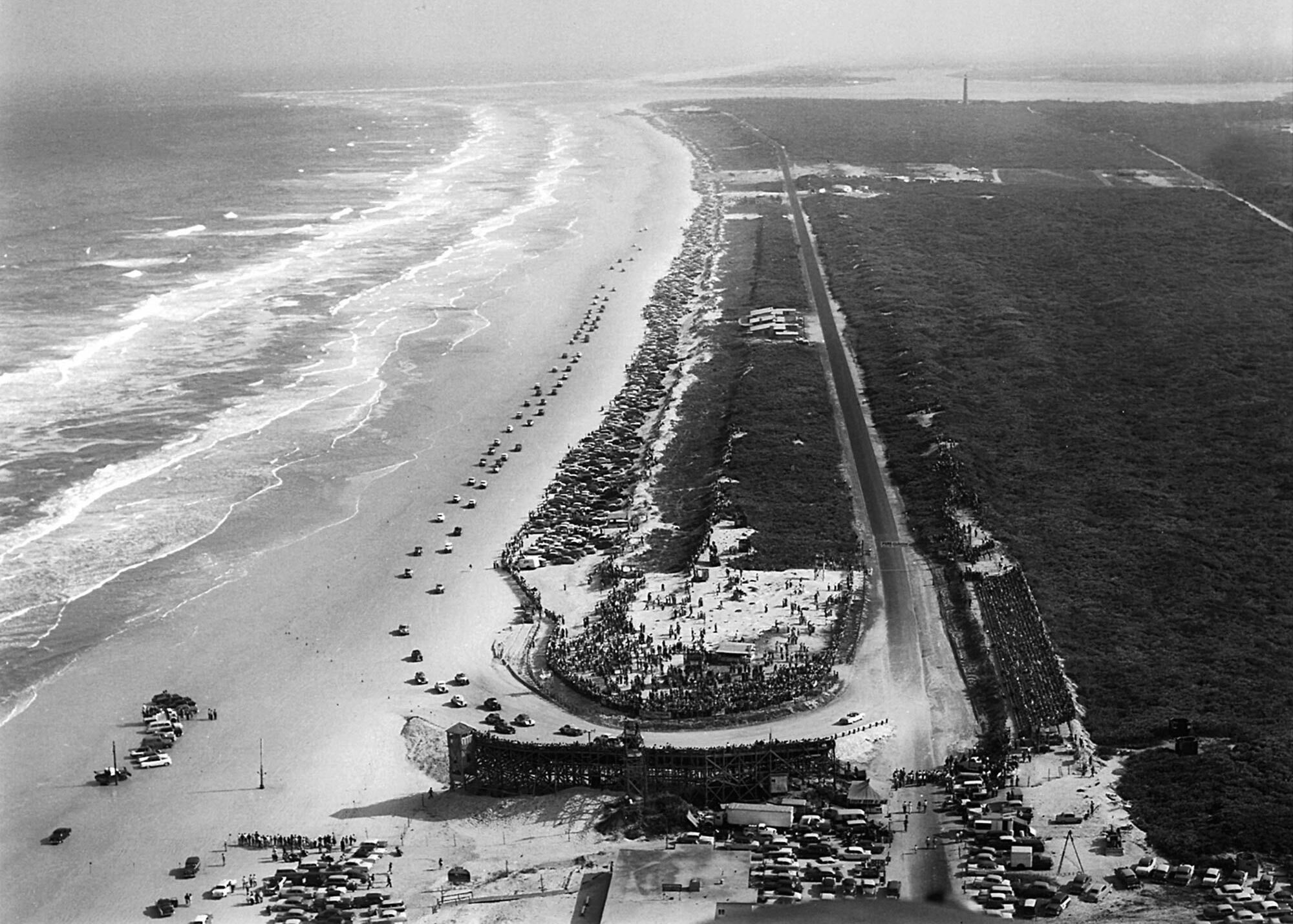
The connection ran back further than the track. Rolex dates its links to motor sport to 1930 and Sir Malcolm Campbell, who set the world land speed record nine times between 1924 and 1935, including the first run past 300 miles an hour.2 Daytona Beach was where a good deal of that happened: by Rolex's own account the beach holds fourteen world land speed records set between 1904 and 1935, five of them by Campbell. The sand deteriorated, and by 1959 a Super Speedway had been built in its place, the Daytona International Speedway, which Rolex partnered in that year.2
So by 1963 Rolex had a speed heritage, a driver, a racetrack contract and a new chronograph, and the only thing missing was a word that joined them.
The name arrived before the dial did
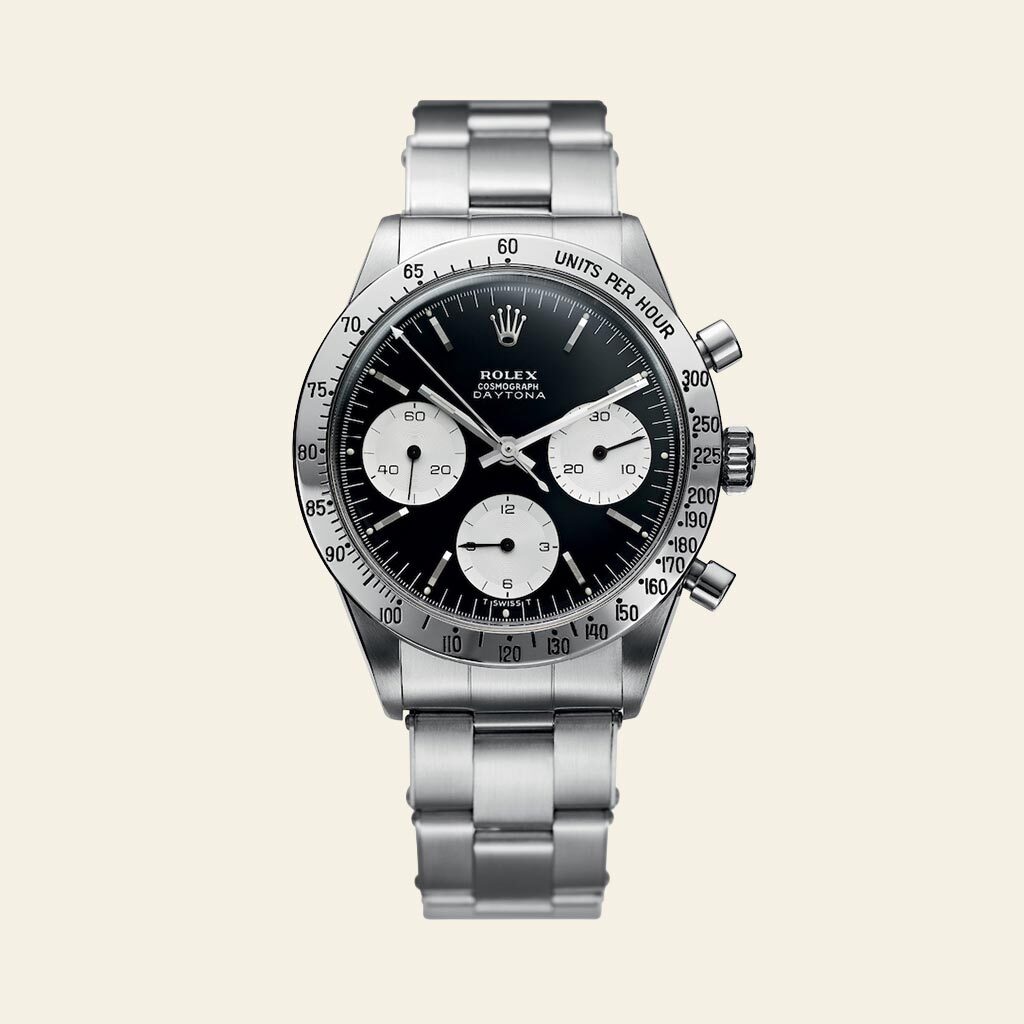
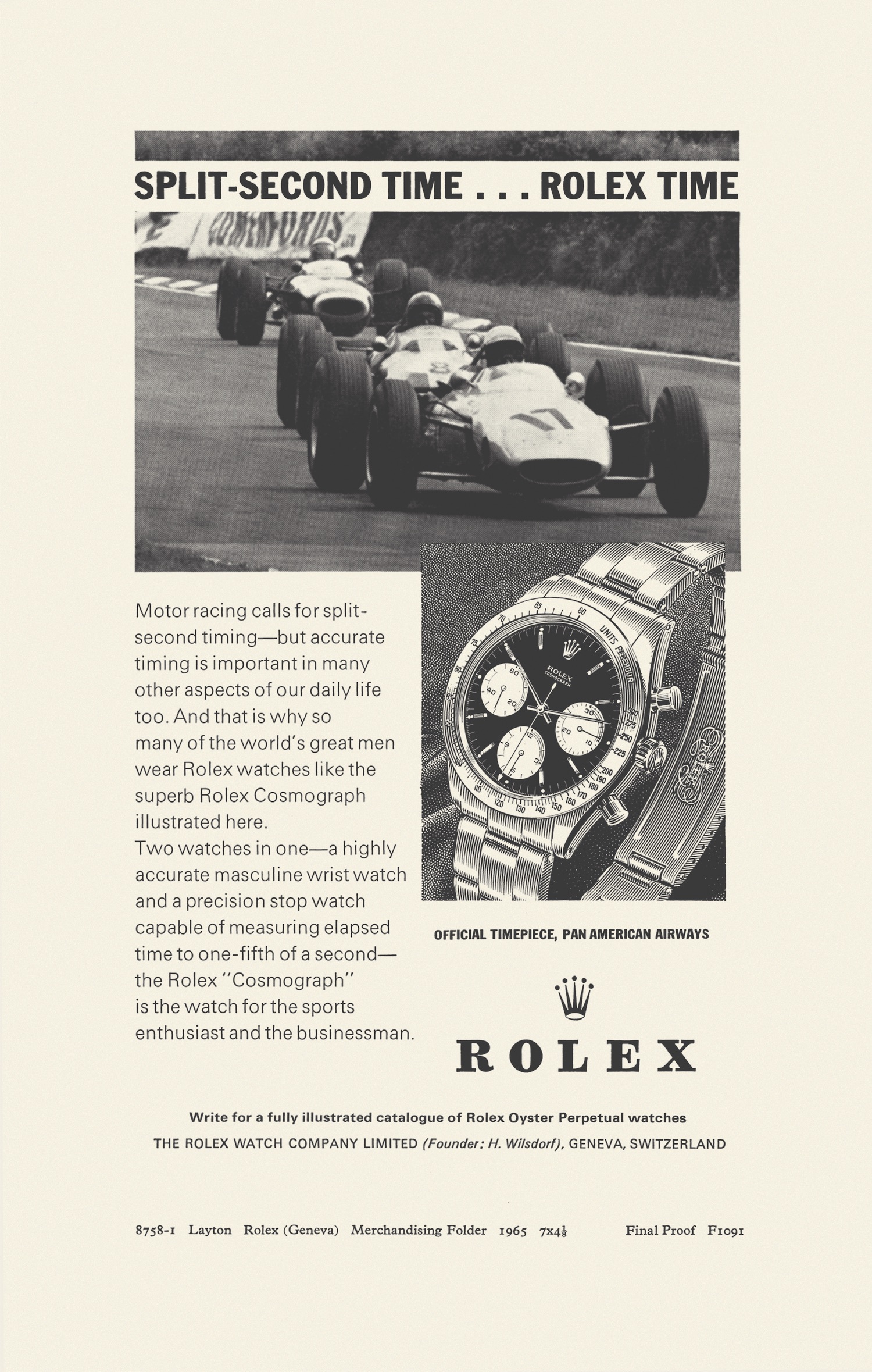
The watch went on sale as the Cosmograph, was advertised for a period as the Le Mans, and only later carried the word Daytona on its dial, below the twelve o'clock signature from 1964 or 1965 depending on the account, and above the six o'clock sub-dial by 1967.3, 4 Rolex did not name a product and then go looking for a track to match it. It was already paying for the track.
The company now tells that in two incompatible ways. Its partnerships page claims the decision: "In 1963, Rolex gave its latest model the name Cosmograph Daytona to symbolize its connection with the renowned racetrack in the United States."2 Its corporate history describes something closer to an accident: the Cosmograph "soon gained the name that became the mark of an icon: Daytona."1
For the brand, both versions pay. Gave makes the naming look like strategy and credits the company with foresight. Gained makes it look like the market chose, which is the stronger claim of the two, because a name customers impose cannot be dismissed as marketing. Rolex has never had to choose, and the value of the word does not depend on which account is true. What the episode settles is the direction a sponsorship can run in. A brand that pays for a property usually borrows its audience; here it took the property's name and kept it.
The name outgrew the watch
Rolex now concedes the shorthand in its own copy, writing that the model is "known simply as the 'Daytona'", and it has let the word run in both directions.1 The endurance race at the speedway is styled the Rolex 24 At DAYTONA, so the brand name and the place name are printed together on the event that produced the product name.2 Rolex has sponsored that race since 1991, and the members of the winning team in each division are each presented with a Rolex Daytona.3
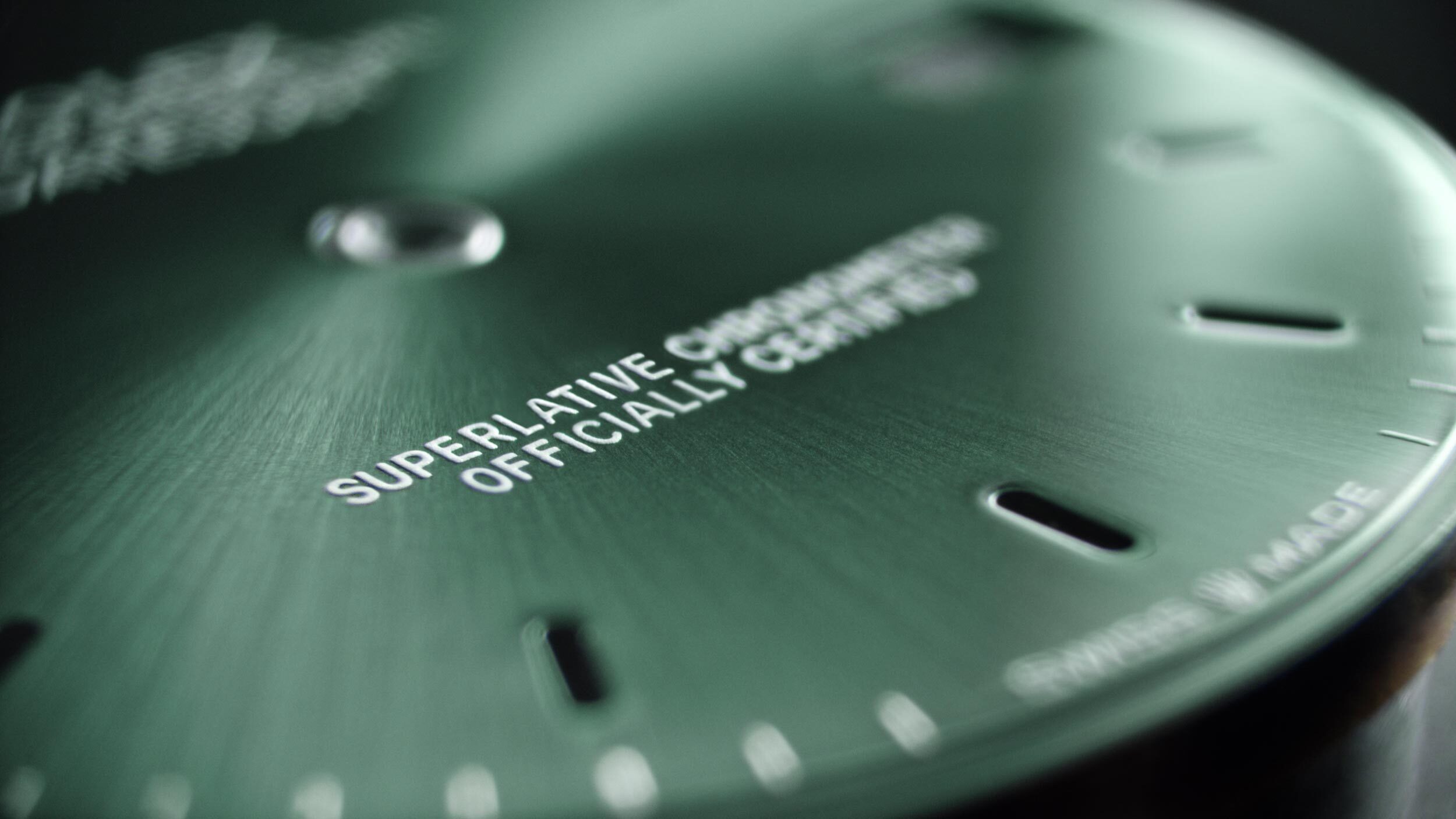
Borrowing a name is not the cheap option it looks like. Oyster, Perpetual, Superlative Chronometer and Testimonee are words Rolex took into its own vocabulary and registered, which is why it can control them. Daytona belongs to a city and to a speedway the company does not own, and the watch's most valuable word is one a third party could in principle have withheld. Rolex answered that by never letting go of the association: the sponsorship has outlasted the naming by more than sixty years, and the word now appears on the dial, on the race and on the trophy at the same time.
A place gave its name to a track, the track gave its name to a watch, and the watch is now handed out as the prize at the race on the track. Rolex has spent a century claiming names and keeping them, from Oyster and Perpetual to Testimonee. Daytona is the one it did not have to claim on its own.
Written with AI assistance, edited by a human. Find out more about our Use of AI.
1. Rolex, "Rolex History, 1953 to 1967", retrieved 21 September 2026, for the Cosmograph launched in 1963 as a new-generation chronograph described by Rolex as designed for endurance racing drivers, robust, waterproof and with a tachymetric scale on the bezel for calculating average speed, for the sentence stating that the Cosmograph soon gained the name Daytona, and for the model being known simply as the Daytona. https://www.rolex.com/en-us/about-rolex/history/1953-1967
2. Rolex, "Behind the crown, Rolex and Partners", retrieved 21 September 2026, for the beginning of the motor sport links in 1930 with Sir Malcolm Campbell and his nine world land speed records between 1924 and 1935 including the 300 mile per hour barrier, for the fourteen world land speed records set at Daytona Beach between 1904 and 1935 with five by Campbell, for the building of the Daytona International Speedway by 1959 and Rolex partnering it in that year, for Rolex partnering the Daytona International Speedway in 1959, for the sentence stating that in 1963 Rolex gave its latest model the name Cosmograph Daytona to symbolize its connection with the racetrack, and for the styling of the race as the Rolex 24 At DAYTONA. This page and the corporate history cited in note 1 give different accounts of whether Rolex gave the name or the watch gained it; both are reproduced and neither is preferred. https://www.rolex.com/en-us/about-rolex/behind-the-crown/rolex-partners
3. Wikipedia, "Rolex Cosmograph Daytona", read 21 September 2026, for the 1963 launch as reference 6239, for Rolex becoming official timekeeper of the Daytona International Speedway in 1962, for the word Daytona being added below the Rolex Cosmograph signature on the dial in 1964 and moved above the six o'clock sub-dial by 1967, for Rolex sponsoring the endurance race since 1991, and for the members of the winning team in each division being presented with a Rolex Daytona. The dial year in this source differs by one year from the specialist history cited in note 4. https://en.wikipedia.org/wiki/Rolex_Cosmograph_Daytona
4. Time and Watches, "The Rolex Daytona history", read 21 September 2026, for the introduction of the first Cosmograph as reference 6239 in 1963, for the statement that in 1965 the Daytona name finally appeared also on the dial, and for the statement that Rolex initially used the name Le Mans in some advertisements before opting for Daytona. Time and Watches is a watch specialist and is not on the journal's source whitelist; it is cited for the Le Mans advertising claim, which no permitted source carries, and for the competing dial year. https://www.timeandwatches.com/p/history-of-rolex-cosmograph-daytona.html