A second floor café on Fifth Avenue
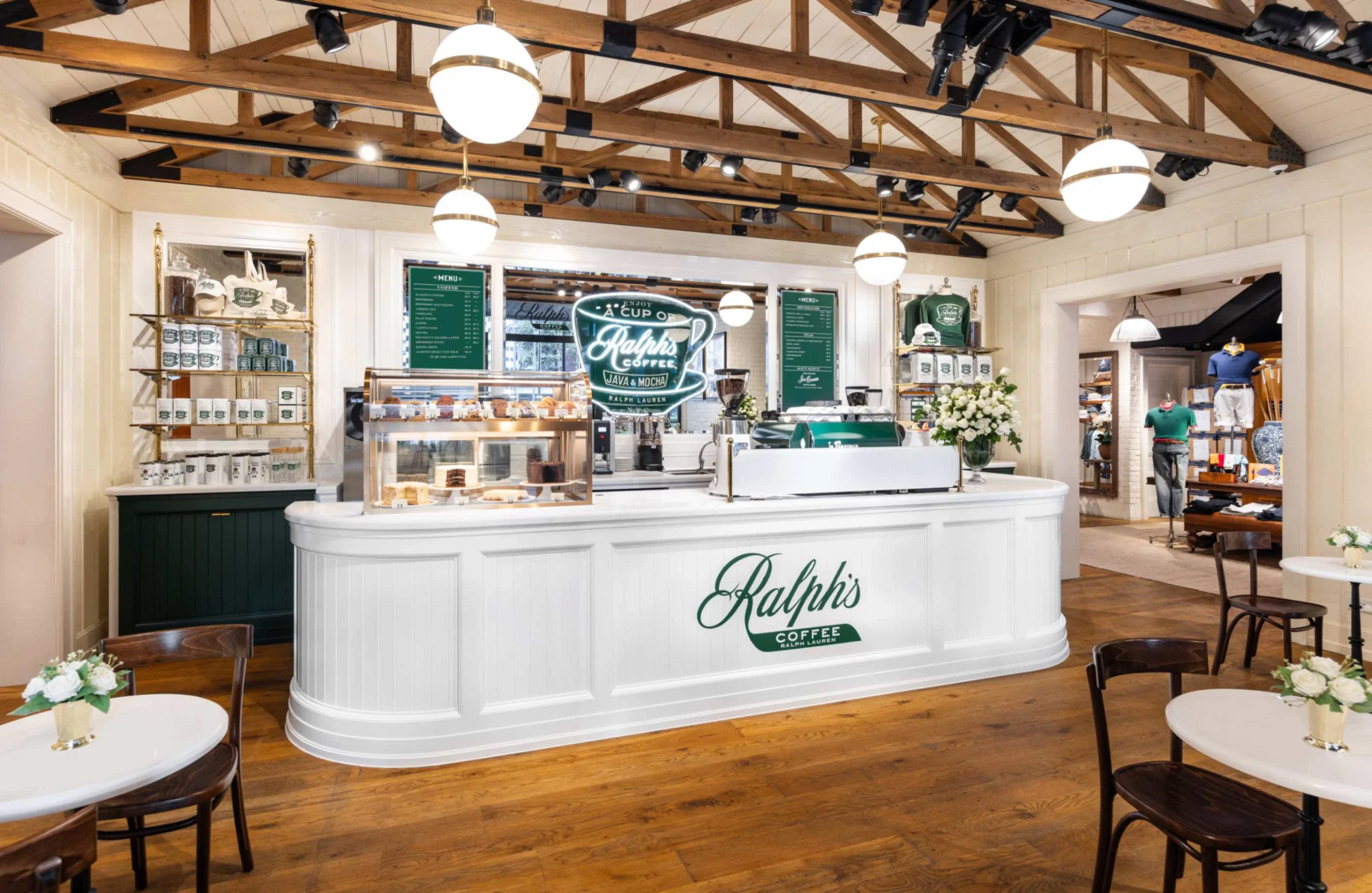
In September 2014, Ralph Lauren opened Ralph's Coffee on the second floor of the new Polo Ralph Lauren flagship at 711 Fifth Avenue, on the corner of 55th Street in New York.1, 2, 3 The café occupied a corner of the men's store that had been designed from the outset to carry hospitality rather than merchandise. It was the brand's first coffee shop and the formal beginning of a coffee programme that has since extended to more than 40 locations across North America, Europe and Asia.1, 4
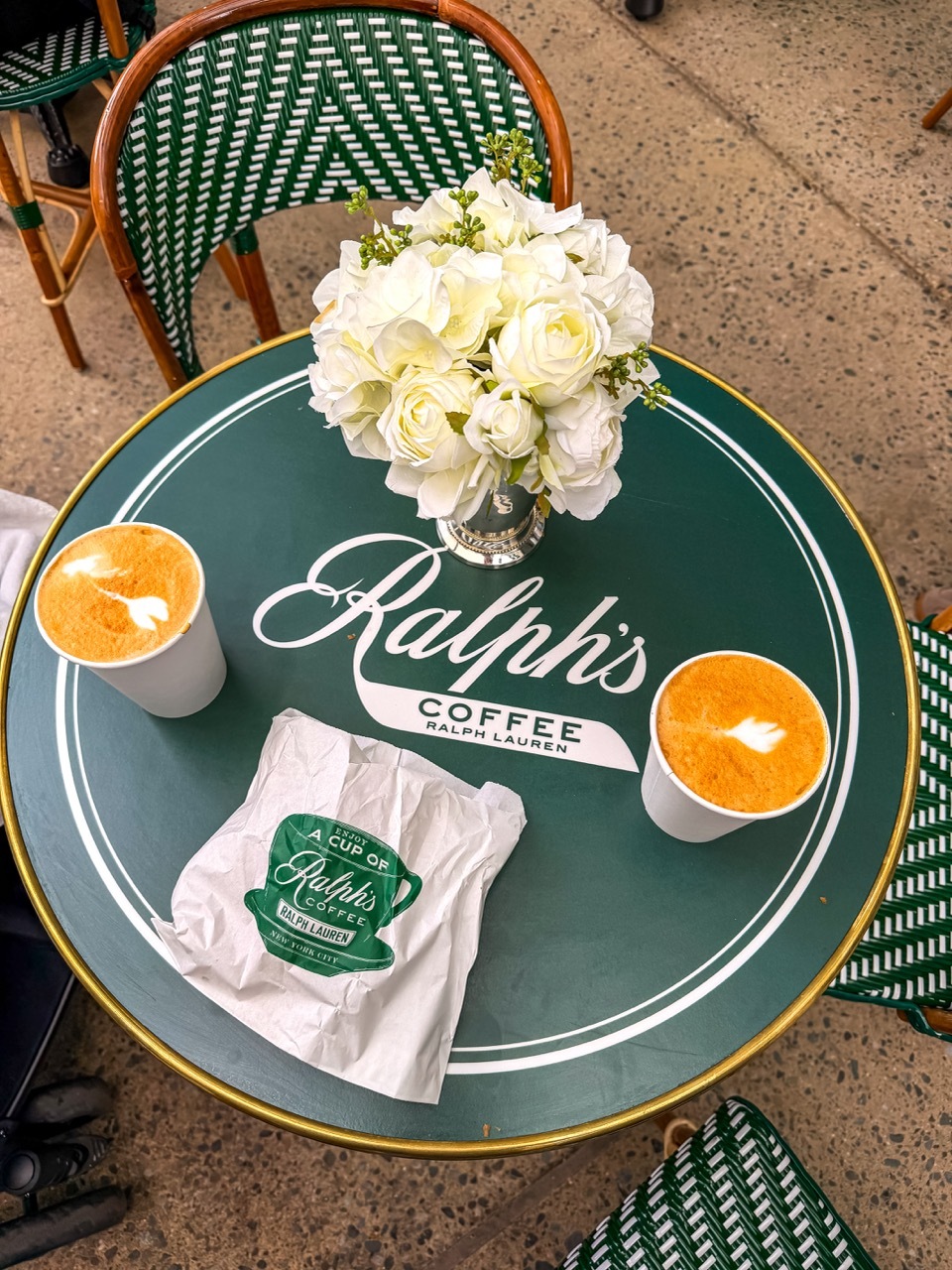
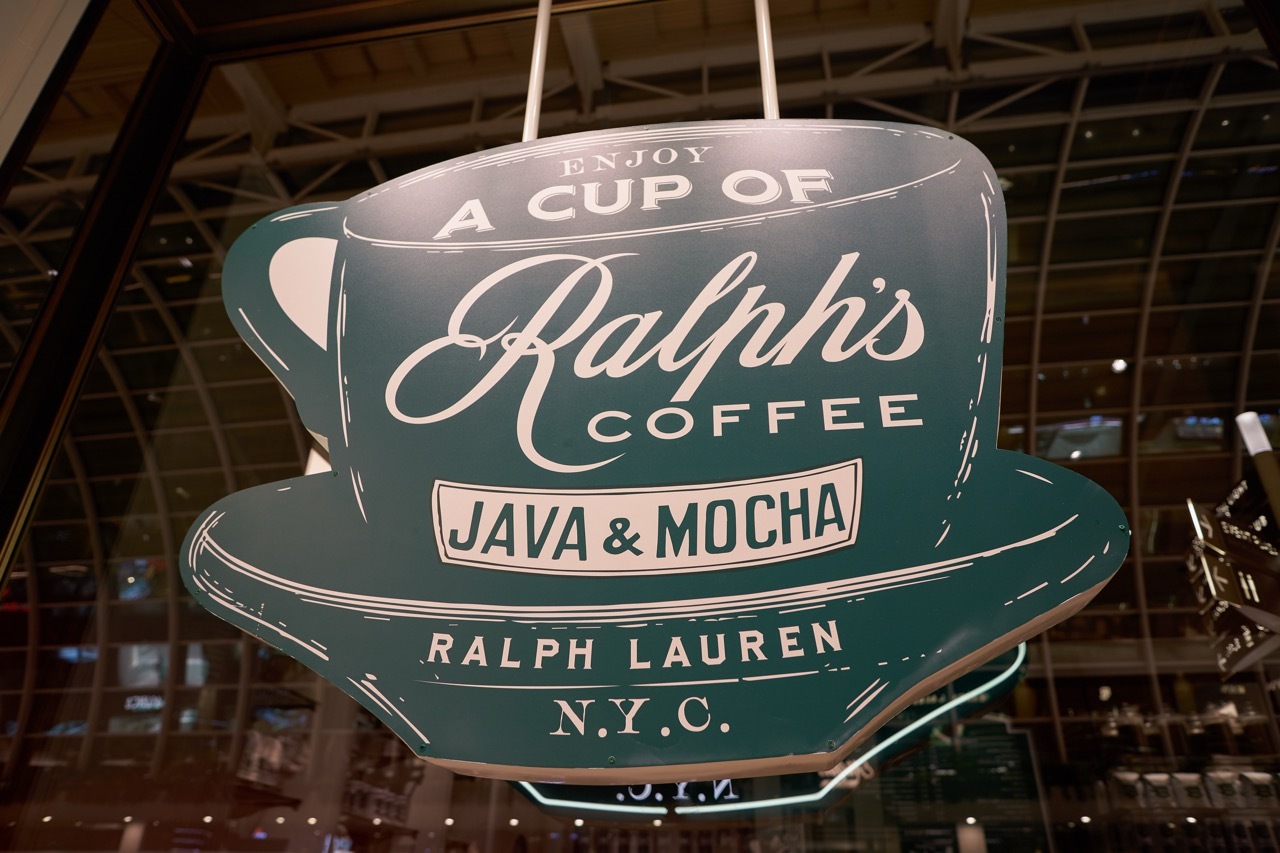
The room read as a calibrated extract of the Ralph Lauren retail dictionary. White subway tiled floors and white bead board walls set a clean ground.5 Eighteen foot oak columns anchored the volume.5 Marble top tables and antique bistro chairs filled the floor.5 A custom green wordmark, drawn in a hand cut sans serif and set inside a circular badge, ran across the takeaway cups, the napkins and the signage. The room asked to be photographed and was, repeatedly, in the months that followed.
A pop up that earned a permanent address
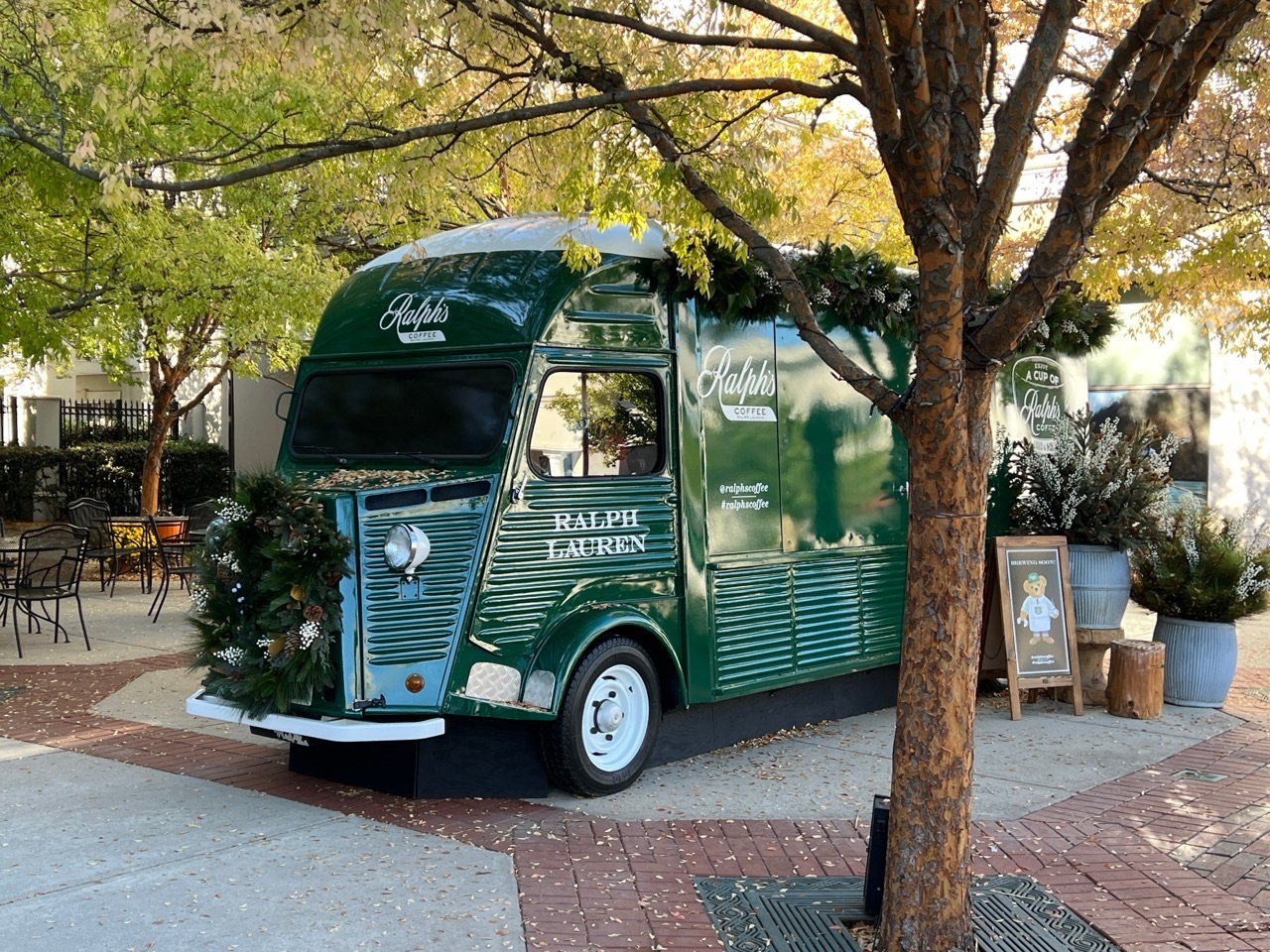
The brand had tested the idea earlier the same year with a Ralph's Coffee Truck that travelled around Manhattan. The truck served the same blends in the same packaging and produced the same response in the same press outlets. By the time the second floor café opened, the visual identity, the menu architecture and the operational model were already documented. The flagship build out was the upgrade of a working prototype rather than the launch of a new concept.
The Polo Bar, a sit down restaurant in the lower level of the same building, followed in January 2015.1, 6 Together, Ralph's Coffee and The Polo Bar turned 711 Fifth Avenue into a hospitality address as much as a retail address. The architecture of the project, with food, beverage and merchandise stacked on adjacent floors of a single building, anticipated the integrated lifestyle floors that other luxury houses opened in Tokyo, Paris and London later in the decade.
The product programme
The coffee programme was built with La Colombe, the Philadelphia roaster founded in 1994 by Todd Carmichael and Jean Philippe Iberti.5, 7 Beans came from USDA certified organic farms in Africa, Mexico, Central America and South America.8 Three core blends anchored the menu: Ralph's Roast, a balanced everyday cup; a decaffeinated version of the same; and an espresso blend built for the bar.4 The packaging used a matte cream sleeve with the green wordmark and the badge, and was designed to read on a kitchen counter rather than in a coffee aisle.
Ralph Lauren himself framed the programme in a published statement that has since travelled across all subsequent café openings.
"The smell of freshly brewed coffee evokes so many memories for me, mostly of time spent with friends and family, the people I love. I wanted to develop these coffee blends in that spirit, and create a place where people could come together and take a break from their busy days."4, 5
The statement set the editorial frame for every later location. Ralph's Coffee was not positioned as a luxury extension or as a competitor to the third wave specialty cafés that dominated the New York scene in 2014. It was positioned as a hospitality gesture rendered in the brand's own visual code.
Why a coffee shop, and why now
By 2014, Ralph Lauren Corporation had been listed on the New York Stock Exchange for 17 years and had built a portfolio that ran from Purple Label tailoring to Double RL workwear, from Polo Ralph Lauren home to children's licensing.1, 7 The brand's expansion problem at that stage was not assortment. It was atmosphere. Retail visits had moved partially online and competing American houses had begun to invest in restaurants, members' lounges and hospitality venues as ways to keep the in person brand encounter productive.
Ralph's Coffee answered that problem with the smallest possible vehicle. A cup of coffee was a portable carrier of brand atmosphere. The cup, the wordmark, the napkin and the takeaway bag travelled to the office, to the park bench, to the social feed of the customer. Each carrying surface continued the brand's visual code outside the store at a per impression cost lower than any other format the company operated. The product was almost incidental to the design of the asset.
The platform that the verse anchors
The Fifth Avenue flagship that housed the first Ralph's Coffee closed in early 2017 under wider Ralph Lauren Corporation restructuring, but the coffee programme outlived the store.9 New locations opened on Madison Avenue, in Mayfair London, in Roppongi Tokyo, in Hong Kong, in Paris, in Milan, in Boston Seaport and in Tysons Galleria.4, 9 Trucks and trikes appeared at sailing regattas, polo tournaments and seasonal pop ups in Manhattan, the Hamptons and Aspen. The format remained constant: the same wordmark, the same blends, the same green packaging, the same hospitality script.
Read this way, Ralph's Coffee belongs in the same category as the Hermès silk square or the Tiffany blue box, a small object designed to carry the brand's full atmosphere on a single surface. The 711 Fifth Avenue opening in September 2014 was the moment when Ralph Lauren formalised that asset into a permanent operation, and turned a temporary marketing instrument into a category that the brand now runs in three continents.1
Written with AI assistance, edited by a human. Find out more about our Use of AI.
1. Ralph Lauren, "The World of Ralph Lauren Timeline", undated brand page, added during the footnote retrofit, together with Ralph Lauren Corporation, "Hospitality", undated corporate page, to which the dead press release index in the verse's source list was resolved, for the Polo flagship at 711 Fifth Avenue having opened on 8 September 2014, for Ralph's Coffee having debuted on its second floor as Ralph Lauren's first coffee shop, for the company having been listed on the New York Stock Exchange in 1997, and for The Polo Bar having opened in 2015 on East 55th Street, at 1 East 55th Street according to the corporate page. The timeline also records RL Restaurant in Chicago in 1999 and the Paris restaurant on Boulevard Saint Germain in 2010, both earlier food and beverage venues of the brand. https://www.ralphlauren.com/rl-timeline-feat https://corporate.ralphlauren.com/hospitality
2. Habitually Chic, "Chic in NYC: Ralph's Coffee", 17 September 2014, off whitelist, a post of interior photographs, for the new café on the second floor of the new Polo Ralph Lauren store at 711 Fifth Avenue at 55th Street, visited by the author during New York Fashion Week in September 2014. The post's text names no interior materials; those rest on footnote 5. https://www.habituallychic.luxury/2014/09/chic-in-nyc-ralphs-coffee/
3. WWD, "Fifth Ave.: Ralph Lauren's New Neighborhood", date not retrievable, off whitelist, cited in the verse's source list for the context of the new Polo Ralph Lauren flagship on Fifth Avenue. The page returned HTTP 402 and no archived copy could be opened, so its content could not be checked; page not reachable on 26 September 2026. https://wwd.com/fashion-news/designer-luxury/feature/fifth-ave-ralphs-new-neighborhood-7881636-1067701/
4. Ralph Lauren, "Ralph's Coffee", undated brand page, listed in the verse's sources in its German edition and read also in its English edition, together with Ralph Lauren, "Ralph's Coffee Locations", undated, for Ralph Lauren's statement in its original English wording, "The smell of freshly brewed coffee evokes so many memories for me, mostly of time spent with friends and family, the people I love. I wanted to develop these coffee blends in that spirit, and create a place where people could come together and take a break from their busy days.", for the three blends Ralph's Roast, Ralph's Espresso and Ralph's Decaf, all roasted and packaged by La Colombe from organic beans, for the first Ralph's Coffee having opened in 2014 at the corner of Fifth Avenue and 55th Street, and for the locations page listing more than 40 Ralph's Coffee locations across North America, Europe, Asia and the Middle East, among them Madison Avenue, Bond Street in London, St. Germain in Paris, Boston, Washington, D.C., Tokyo and Hong Kong. The German edition carries the statement in German translation only. https://www.ralphlauren.de/de/ralphs-coffee/70702257 https://www.ralphlauren.global/co/en/ralphs-coffee/70702257 https://www.ralphlauren.com/ralphs-coffee-locations-feat
5. Daily Coffee News by Roast Magazine, Nick Brown, "Polo Ralph Lauren Unveils the Ralph Coffee Brand at New York Flagship", 24 September 2014, off whitelist, for Ralph's Coffee on the second floor of the flagship at 711 Fifth Avenue, for its white tiled floors, white bead board walls, 18 foot oak columns and marble top tables with antique bistro chairs, for the coffee being brewed and packaged by Philadelphia based La Colombe, and for Ralph Lauren's statement, carried there in the same English wording as in footnote 4. https://dailycoffeenews.com/2014/09/24/polo-ralph-lauren-unveils-the-ralph-coffee-brand-at-new-york-flagship/
6. Hospitality Design, Alissa Ponchione, "Ralph Lauren Opens Polo Bar in New York", 12 January 2015, off whitelist and used for corroboration only, added during the footnote retrofit, for The Polo Bar, Ralph Lauren's first restaurant in New York City, having opened by January 2015 next to the Polo Ralph Lauren flagship, with bar service on the first floor and the main dining room downstairs, and for Ralph's Coffee having opened on the flagship's second floor in early September 2014. https://hospitalitydesign.com/news/ralph-lauren-opens-polo-bar-in-new-york/18784/
7. Wikipedia, "Ralph Lauren Corporation" and "La Colombe Coffee Roasters", accessed 26 September 2026, for the company having become publicly traded on the New York Stock Exchange on 12 June 1997, for Purple Label, RRL, Ralph Lauren Home and Polo Ralph Lauren Children among its lines, and for La Colombe having been founded in 1994 by Todd Carmichael and JP Iberti and being headquartered in Philadelphia. The corporation article dates the café's opening to August 2014, which the brand's own timeline in footnote 1 does not bear out. https://en.wikipedia.org/wiki/Ralph_Lauren_Corporation https://en.wikipedia.org/wiki/La_Colombe_Coffee_Roasters
8. Hypebeast, Gavin Yeung, "Ralph's Coffee at Polo Ralph Lauren", 9 October 2014, off whitelist, for the café on the second floor of the Polo Ralph Lauren flagship at 711 Fifth Avenue and for its privately blended USDA organic coffees with beans sourced from Africa, Mexico and Central and South America. https://hypebeast.com/2014/10/ralphs-coffee-at-polo-ralph-lauren
9. The Robin Report, Jane Singer, "Ralph Makes a Cup of Coffee", 27 May 2019, off whitelist, for the Polo store on Fifth Avenue having opened in 2014 and closed in early 2017 amid disappointing sales and corporate restructuring, for Ralph's Coffee in the Ralph Lauren Mansion at Madison Avenue and 72nd Street, across the street from the Rhinelander Mansion, and for Ralph's Coffee shops in Hong Kong and Tokyo. https://therobinreport.com/ralph-makes-a-cup-of-coffee/