
The first sighting on a shirt cuff
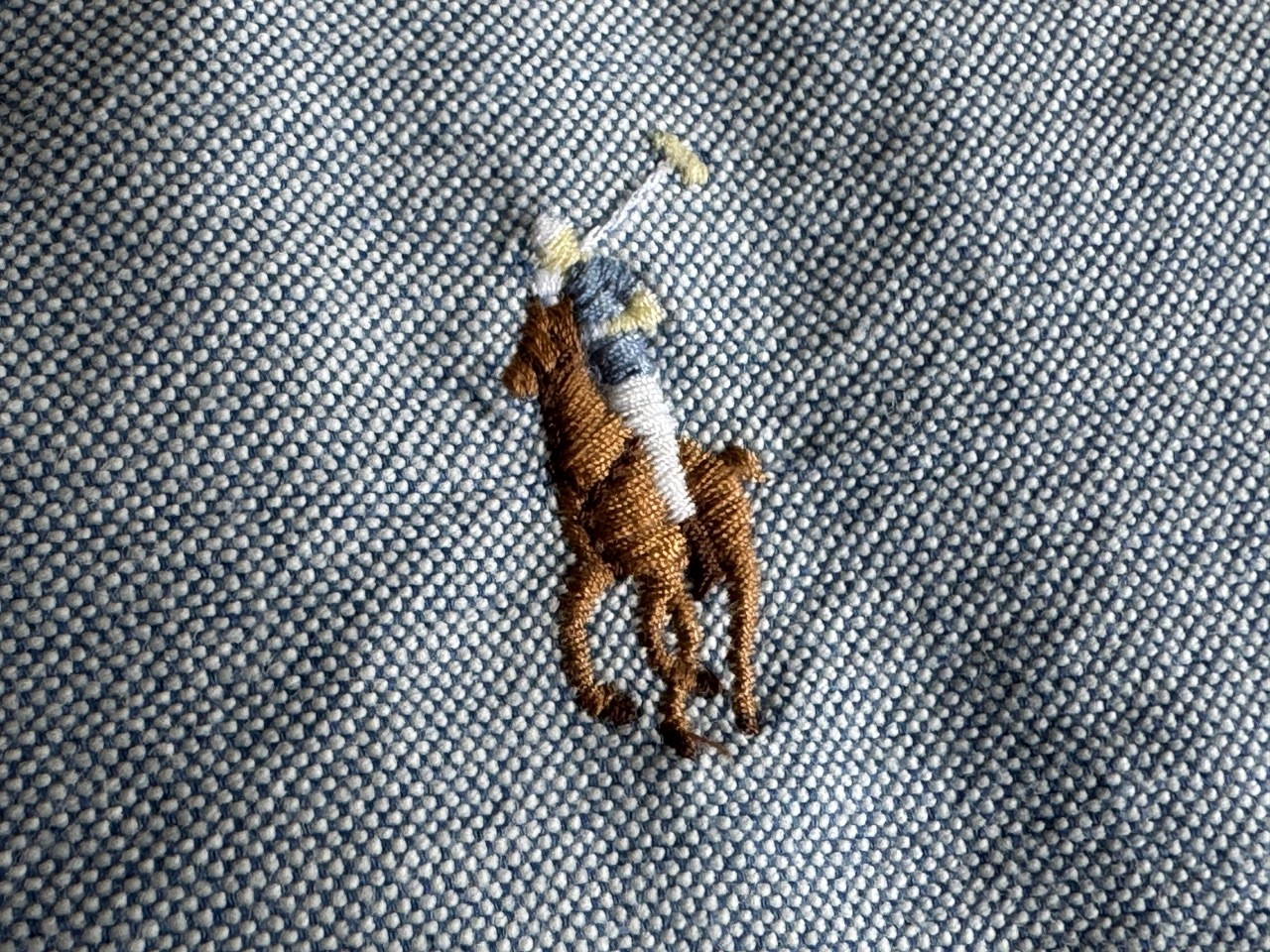
In 1971, Ralph Lauren introduced the Polo Player emblem, an embroidered figure of a horse-mounted polo player at full gallop with a raised mallet, on the cuff of a line of tailored women's shirts. It was the first appearance of the mark that would later be recognised on every continent. The placement on the cuff was deliberately discreet. Lauren has described the emblem in interviews as functioning almost like jewellery, a small mark intended to give a familiar garment an additional layer of identity rather than to dominate it. The 1971 women's shirts were the first complete women's line offered by the company and the launch context for the emblem itself. The original drawing is widely attributed to early Ralph Lauren collaborator Tracy Mews, with the figure modelled informally on the polo player Bennie Gutierrez.
A symbol drawn from the brand name
Lauren had named his menswear line Polo in 1967. The 1971 emblem made the name visual. By taking the brand's central word and translating it into a literal pictogram, Ralph Lauren produced one of the most legible logo systems in late twentieth-century fashion. The figure communicates the brand's positioning even to a viewer who cannot read the label. It signals equestrian sport, English country reference, leisure, athletic pose, animal grace and a particular kind of aspirational ease. None of those associations had to be argued for. The image carried them. That economy of meaning is the reason the emblem became one of the most copied marks in the history of the apparel industry, the visible target of decades of counterfeiting and homage.
The cuff before the chest
The choice to debut the emblem on the cuff of a women's shirt rather than on a more prominent placement is an underappreciated detail of the launch. Lauren's stated approach was that branding should reward the wearer first. A logo at the cuff is visible to the person who buttoned the shirt and to those close to them, but is not declarative. The placement protected the new emblem from being read as ostentatious in 1971, a period in which conspicuous logo wear was still relatively unusual outside athletic and youth markets. The cuff debut in 1971 set up the move to the chest, the placement that would become globally recognisable, on the original mesh Polo shirt for men in 1972.
From women's tailoring to a category-wide signature
The 1971 use of the emblem on women's tailored shirts was the first step in a programmatic rollout. The 1972 mesh Polo shirt for men placed the emblem on the chest and offered it in twenty-four colours, transforming the mark into a broadly visible signal across leisure and sport. From the mid-1970s the emblem appeared on knitwear, sweaters, jackets, accessories and home goods. By the mid-1980s it had become one of the most recognisable apparel logos in the United States and was extending through licensed product into international markets. The same emblem, with relatively modest variation in size, scale and outline, has continued to operate across the Polo Ralph Lauren, Polo Sport, Purple Label, Double RL, Polo Golf and Lauren ranges, calibrated for each context but never replaced.
A craftsman's drawing rather than a corporate identity
The 1971 emblem was not produced through a formal corporate identity exercise. There was no agency briefing, no benchmark set, no system of variants and no usage guide of the kind that became standard in late twentieth-century branding practice. The emblem was simply drawn, embroidered on a sample garment and approved by Lauren himself. That informal origin is one reason the asset feels different from contemporaneous corporate logos. It looks hand-drawn, slightly imperfect and human. Subsequent revisions across the decades have preserved that quality rather than smoothed it. The emblem still carries the visible character of an embroidered drawing, even at very small scales and on machine production.
The emblem as a piece of intellectual property
From a brand-strategic perspective, the 1971 introduction of the Polo Player emblem produced one of the most valuable assets in the Ralph Lauren Corporation's intellectual property portfolio. The figure is figurative enough to be ownable and protectable in trademark law, distinctive enough to remain instantly recognisable across every reproduction medium, and culturally embedded enough that imitation reinforces rather than dilutes its identity. Many subsequent fashion logos, both inside and outside the Polo Ralph Lauren competitor set, have referenced the emblem's pictogram model in attempts to achieve similar legibility. Few have matched it. The Polo Player emblem, debuted on a single shirt cuff in 1971, has continued to function as the central graphic asset of the Ralph Lauren brand for more than fifty years.
Written with AI assistance, edited by a human. Find out more about our Use of AI.