
Global home furnishings retailer founded in Sweden in 1943, organised around democratic design and a brand vision of creating a better everyday life f…
16 Articles
Global technology company defining premium consumer electronics, software, and services through an identity built on simplicity, craft, and a tightly …
23 ArticlesThe catalogue stepped into the room
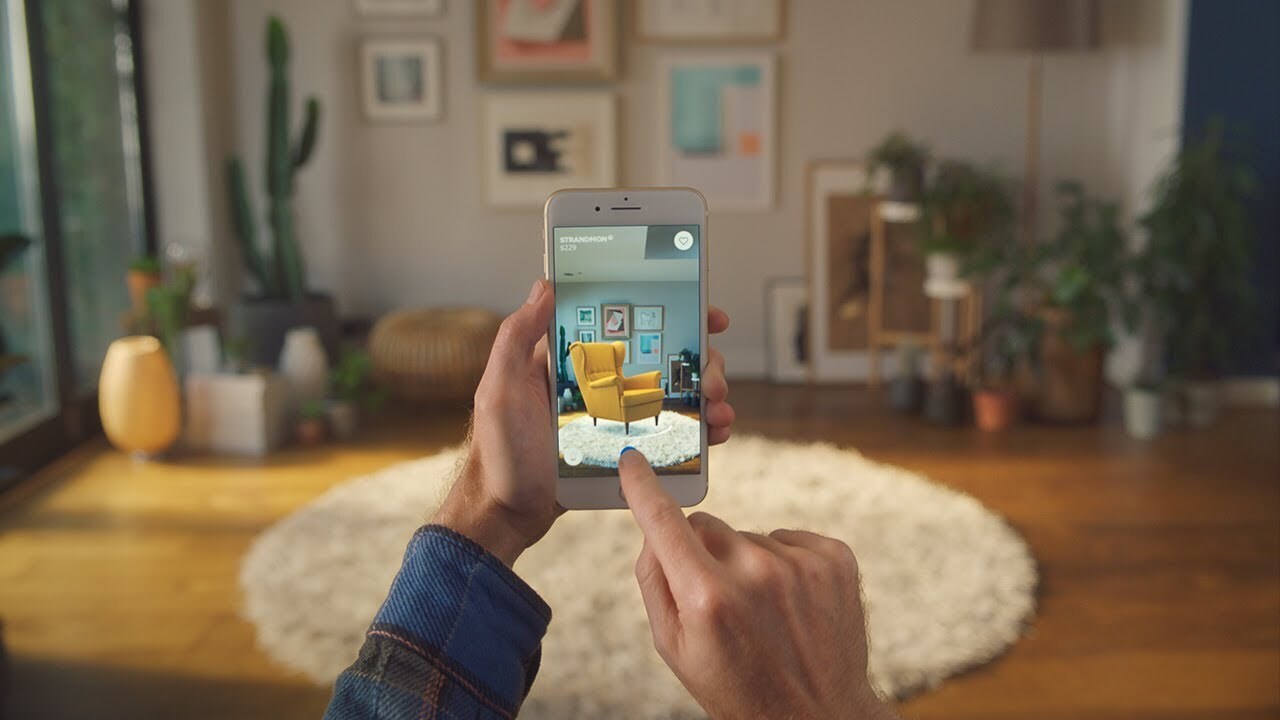
On 19 September 2017, the day Apple released iOS 11, Inter IKEA Systems made the IKEA Place app available on the App Store, starting in the United States.1, 2 The application used ARKit, Apple's new mobile augmented reality framework, to place true-to-scale three dimensional models of more than 2,000 IKEA products into a real room through the iPhone camera.1, 3 IKEA Place had been previewed at WWDC on 5 June 2017 in the demo that introduced ARKit and was showcased again at Apple's iPhone 8 and iPhone X event on 12 September 2017, where Tim Cook used IKEA Place as one of the on-stage examples for the new platform's consumer reach.4 The IKEA Place release coincided with iOS 11 going live to the public seven days later.1
The strategic premise
The rationale for IKEA Place sat directly inside IKEA's long-running argument about democratic design. Inter IKEA Systems framed the project as a way to reduce the gap between selecting a piece of furniture and trusting that it would fit the room it was being bought for.3 Survey data inside IKEA's planning teams suggested that uncertainty about scale, colour and visual fit was a leading reason for furniture purchases being delayed or returned. The brand's response was to put the showroom into the customer's pocket rather than to expect the customer to come to the showroom.
The brief was clear in its scope. The app was not a sales tool first, it was a confidence tool. Its job was to let a person stand inside a room and see, in scale, what an IKEA armchair, sofa, bookcase or table looked like in that exact space. Purchase was a downstream effect, not the first feature. That framing kept the experience editorial rather than transactional, and aligned IKEA Place with the brand's wider Wonderful Everyday register rather than with promotional retail apps.
The development partnership
IKEA Place was built by Inter IKEA Systems with Space10 and TWNKLS, which handled the user experience and development of the app.2 The development brief was to translate the IKEA range into accurate 3D assets, to design an interface clean enough for a customer to use without instruction, and to integrate ARKit's plane detection in a way that handled domestic clutter, mixed light and irregular floor surfaces. The 3D library was built and validated against IKEA's own technical drawings, with photographic texture maps captured directly from in-store products in Älmhult.
The launch range carried 2,000 products covering sofas, armchairs, footstools, coffee tables, side tables, beds, bookcases, storage and accessory items.3 Materials, finishes and fabric variants were modelled to a tolerance fine enough that ARKit's lighting estimation, the framework feature that picked up ambient light from the camera and applied it to the rendered model, produced believable shadows and reflections.5 The scale accuracy was reported by IKEA at 98 percent.3
The Apple stage
Apple's ARKit reveal at WWDC 2017 used IKEA Place as one of three flagship demonstrations. Tim Cook returned to it in September 2017 at the Steve Jobs Theater during the iPhone 8 and iPhone X event, framing IKEA Place as evidence that ARKit could carry mainstream consumer use cases on day one of iOS 11. The two appearances on Apple's main stage gave IKEA Place a level of editorial visibility that no IKEA app had previously commanded. Coverage in The Verge, TechCrunch, Wired and Fast Company treated the app as the most credible early ARKit experience on the App Store.5, 6
For IKEA, the alignment with Apple was strategic. The brand's earlier digital experiments, including a 2013 catalogue with augmented reality mark recognition, had been functional but not editorial.4 IKEA Place was treated as a reset, a moment in which the brand could be discussed alongside Apple, ARKit and the broader emerging frame of mobile augmented reality. The value to the brand was both functional and reputational.
The reception
The launch reception in trade press was strong. The Verge described IKEA Place as the most polished ARKit app available at iOS 11 release.6 TechCrunch covered the underlying 3D rendering pipeline and the lighting fidelity.5 Wired ran a piece on the planning behind the app and on Inter IKEA Systems' wider digital direction under Michael Valdsgaard, then leader of digital transformation.3, 6 The 2017 launch coverage repeatedly returned to the strategic significance of IKEA being the first major retailer to put a credible AR experience on the App Store.
Adoption metrics were reported in subsequent quarters. IKEA Place crossed 8.5 million downloads within its first 18 months and was localised across major IKEA markets. The app became a reference point in Apple's own ARKit case-study material at WWDC 2018 and was cited in retail industry conferences as a benchmark for the use of augmented reality in mainstream consumer commerce.
The longer arc
IKEA Place sat at the front of a wider digital reset for IKEA. The brand released IKEA Studio for iPad in 2021 with whole-room scanning for design.7 IKEA Kreativ followed the original IKEA Place experience in the United States in 2022, without replacing it, and integrated machine learning for room recognition.8 The 2020 announcement that the printed catalogue would end after the 2021 edition was framed by IKEA's leadership as part of the same trajectory that began with IKEA Place.7 Read in retrospect, the 19 September 2017 launch is the date on which IKEA's editorial confidence in software became visible to the wider design and retail press, and it is the moment from which IKEA's brand voice began to widen from print to digital, four years before the printed catalogue's end.
Source: IKEA Youtube
Source: IKEA Youtube
Written with AI assistance, edited by a human. Find out more about our Use of AI.
1. iOS 11 and ARKit. Apple Newsroom, "iOS 11 brings powerful new features to iPhone and iPad this fall", 5 June 2017, the release listed under this title in the verse's sources, for ARKit as Apple's new platform letting developers place virtual content on top of real-world scenes, including for immersive shopping experiences, and for Apple having demonstrated it at the Worldwide Developers Conference; the address carried in sources.md returned a 404 and the release is cited at its working address. https://www.apple.com/newsroom/2017/06/ios-11-brings-new-features-to-iphone-and-ipad-this-fall/ Apple Newsroom, "iOS 11 is available tomorrow", 18 September 2017, cited in place of that dead address for iOS 11 going live to the public from Tuesday 19 September 2017, which dates the release of the app, and for augmented reality reaching hundreds of millions of iPhone and iPad devices with it. https://www.apple.com/newsroom/2017/09/ios-11-available-tomorrow/ Apple Developer, "Create Augmented Reality Experiences with ARKit", 5 June 2017, cited in place of the WWDC 2017 video page listed in sources.md, which now opens Apple's current WWDC catalogue, for ARKit being introduced with iOS 11 as a new framework for augmented reality on iPhone and iPad. https://developer.apple.com/news/?id=06052017b https://developer.apple.com/videos/play/wwdc2017/ Wikipedia, "iOS 11" and "ARKit", retrieved 25 September 2026, for iOS 11 having been introduced at the WWDC keynote on 5 June 2017 and released to the public on 19 September 2017, and for ARKit as the interface that lets third-party developers build augmented reality apps with the device's camera and motion sensors. https://en.wikipedia.org/wiki/IOS_11 https://en.wikipedia.org/wiki/ARKit
2. Launch and development partners. LBBOnline, "Ikea Launches Ikea Place, A New AR App That Lets You 'Place' Furniture in Your Home", 19 September 2017, no byline, off whitelist and added during the retrofit, for the app being available on Apple's App Store from 10 am PT that day, for its global rollout on iOS 11 starting on 19 September in the USA, and for Inter IKEA Systems having partnered with Space10 and TWNKLS for the user experience and development of the app, with 72andSunny Amsterdam on strategy, communications planning and creative assets. https://lbbonline.com/news/ikea-launches-ikea-place-a-new-ar-app-that-lets-you-place-furniture-in-your-home TWNKLS, "IKEA Place", agency case study, undated, off whitelist and used for corroboration only, for TWNKLS having developed IKEA Place as one of the launch apps for ARKit and iOS 11. https://twnkls.com/en/cases/ikea-place/
3. IKEA Newsroom (Inter IKEA Systems), "IKEA Place app launched to help people virtually place furniture at home", 12 September 2017, the launch release behind the Inter IKEA newsroom entry in the verse's sources, for IKEA Place being built on Apple's ARKit, for more than 2,000 IKEA products at launch, for the first release concentrating on sofas, armchairs, footstools, coffee tables and top-selling floor storage, with the LISABO side table among the named products, for the app scaling products to room dimensions with 98 percent accuracy, for the stated aim of making it easier to make buying decisions in your own place, and for Michael Valdsgaard as Leader Digital Transformation at Inter IKEA Systems. https://www.ikea.com/global/en/newsroom/innovation/ikea-launches-ikea-place-a-new-app-that-allows-people-to-virtually-place-furniture-in-their-home-170912/ IKEA Korea Newsroom, "IKEA KOREA launches IKEA Place, a furniture-placement app with AR technology", 29 September 2017, added during the retrofit, for the app being released in Korea on 5 October 2017, after the United States. https://www.ikea.com/kr/en/newsroom/corporate-news/page-title-h1-pubb1d8e437/
4. IKEA Newsroom (Inter IKEA Systems), "New collaboration between IKEA and Apple", 7 June 2017, the IKEA newsroom entry in the verse's sources resolved to its article, for the collaboration having been presented at Apple's Worldwide Developers Conference on 5 June 2017 and at the IKEA Democratic Design Days on 7 June, and for IKEA's earlier augmented reality experience with the IKEA Catalogue app "Place in your room". It does not cover the claims about Tim Cook and the September 2017 event, nor the 2013 date of the catalogue app. https://www.ikea.com/global/en/newsroom/collaborations/new-collaboration-between-ikea-and-apple-170607/
5. TechCrunch, Ingrid Lunden, "IKEA Place, the retailer's first ARKit app, creates lifelike pictures of furniture in your home", 12 September 2017, for TechCrunch's launch coverage of the products rendered as three dimensional objects, with shading that responds to the light of the room photographed and the texture of the materials, and for Valdsgaard's remark that most of what the IKEA catalogue shows is rendered and enhanced with light and shadows. The URL listed in sources.md returned a 404; this is the same article at its working address. https://techcrunch.com/2017/09/12/ikea-place-the-retailers-first-arkit-app-creates-lifelike-pictures-of-furniture-in-your-home/
6. Further launch coverage, September 2017, all off whitelist. Fast Company, Daniel Terdiman, "Ikea's AR app lets you test furniture in your home, no Allen wrench needed", 12 September 2017, for Fast Company's report of the app built for iOS 11 with ARKit and more than 2,000 products; the dash in its title is rendered here as a comma. https://www.fastcompany.com/40467131/ikeas-ar-app-lets-you-test-furniture-in-your-home-no-allen-wrench-needed The Verge, report on IKEA Place, 12 September 2017 by its URL, listed in sources.md as "IKEA Place AR app makes furniture shopping fun"; the page could not be fetched, so neither its title nor the characterisation attributed to it in the body could be checked, page not reachable on 25 September 2026. https://www.theverge.com/2017/9/12/16291314/apple-ikea-ar-place-app-arkit-ios-11 Wired, listed in sources.md only as the publisher's homepage with the label "Inside IKEA's digital transformation and IKEA Place"; no matching article could be identified and the site could not be fetched, page not reachable on 25 September 2026. https://www.wired.com/
7. Wikipedia, "IKEA", retrieved 25 September 2026, for IKEA Studio having been launched in 2021 as an augmented reality app for designing full-scale rooms, which Wikipedia describes as an iPhone app, and for IKEA's announcement in December 2020 that the catalogue would cease with the 2021 edition as the final one. It does not cover how IKEA's leadership framed that decision. https://en.wikipedia.org/wiki/IKEA
8. IKEA Kreativ. IKEA US Newsroom, "IKEA launches new AI-powered, digital experience empowering customers to create lifelike room designs", 22 June 2022, added during the retrofit, for IKEA Kreativ first rolling out in the United States and for its use of machine learning and neural networks trained to recognise the objects and geometry of indoor spaces. https://www.ikea.com/us/en/newsroom/corporate-news/ikea-launches-new-ai-powered-digital-experience-empowering-customers-to-create-lifelike-room-designs-pub58c94890/ TechCrunch, Lauren Forristal, "IKEA rolls out an AI-powered interactive design experience for shoppers", 22 June 2022, added during the retrofit, for users still being able to use the separate IKEA Place app alongside the IKEA app that carries Kreativ. https://techcrunch.com/2022/06/22/ikea-rolls-out-an-ai-powered-interactive-design-experience-for-shoppers/