From a Baudelaire stanza to a cinematic platform
In November 2012 Louis Vuitton released the first chapter of L'Invitation au Voyage, a cinematic advertising platform that converted the brand's long-running travel theme from print into film. The title was drawn directly from Charles Baudelaire's 1857 poem of the same name, included in the Spleen and Idéal section of Les Fleurs du Mal, in which the poet calls a beloved companion to journey toward an idealised destination. The first chapter was directed by Bruno Aveillan, photographed by David Sims for the parallel print insertion, and starred the British-American model Arizona Muse. The film was staged inside the Musée du Louvre and ended with Muse rising in a hot-air balloon from the courtyard beneath the glass pyramid.
The decision to anchor the platform on Baudelaire mattered to the way Louis Vuitton positioned the campaign within its communications architecture. The Core Values series, launched in 2007 with Annie Leibovitz and continued through 2012, had built a portrait register around still photography. L'Invitation au Voyage carried the travel theme forward but moved its voice into a thirty-second and ninety-second cinematic format, with an orchestral score and a dramaturgical opening, middle and close. The film was scheduled for international television and cinema slots and ran across digital platforms in a separate cut. The Louvre setting installed the campaign within the French cultural canon and tied the Maison's address to a national museum architecture rather than to an aspirational lifestyle setting.
The Louvre opening and the Aveillan signature
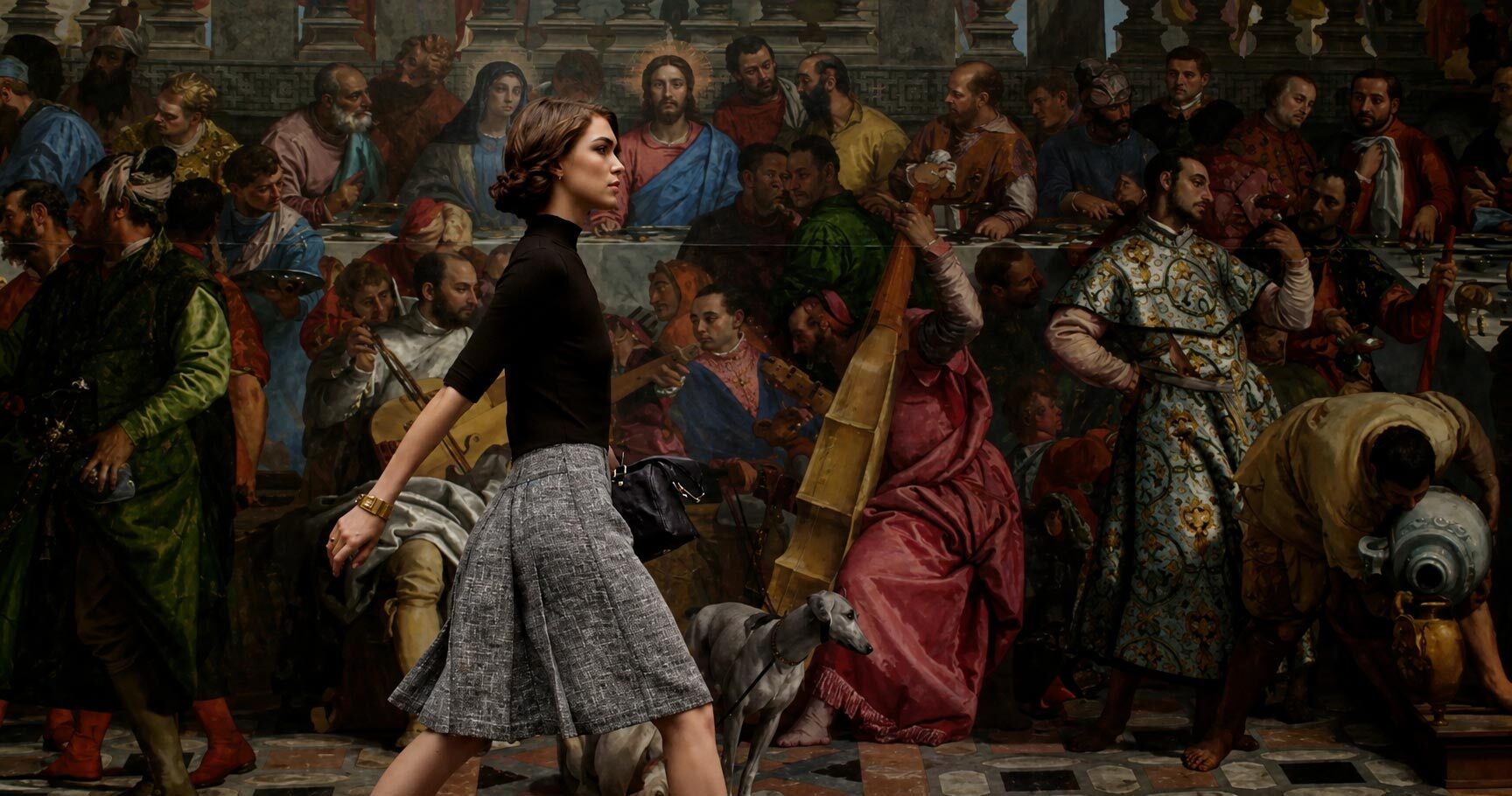
Bruno Aveillan, a French film director associated with luxury advertising work for Cartier, Lancôme and Guerlain, brought a visual approach known across the European advertising press of the period as "cinéma-publicitaire": long takes, low-saturation grading, a single performer photographed from architectural distance. The Louis Vuitton brief gave him the closed Louvre at night, a four-minute setup, a steamer trunk, a balloon and a single model. Muse walked from the Cour Carrée through the Louvre's interior galleries, opened the steamer trunk in the central courtyard, and rose in the balloon from beneath the I. M. Pei glass pyramid. The orchestral score, written for the film by composer Sylvain Coudret, accompanied the sequence without dialogue.
The opening film carried two product references. The steamer trunk, a direct quotation of the flat-topped Vuitton trunks first produced in Asnières in 1859, appeared as the central object of the sequence. The hand-luggage that Muse carried into the balloon was the Speedy 30 in Monogram canvas, a silhouette drawn in 1930 and the most produced bag in the Maison's catalogue by the early 2010s. The film resisted close-up product staging and kept both items at editorial distance.
Source: siuoo Youtube
The Venice chapter with David Bowie
In November 2013, one year after the Louvre release, Louis Vuitton released a second chapter set in Venice. Romain Gavras directed the new film; David Sims continued as photographer of the still campaign. The Venice chapter brought Arizona Muse back as the protagonist and added David Bowie, who appeared seated at a harpsichord at a masquerade ball, performing a stripped harpsichord arrangement of "I'd Rather Be High" from his album The Next Day, released in March 2013. The song's choice was a Bowie decision communicated directly to the brand and was the first commercial use of the track. The Venice setting picked up the balloon arrival from the closing frame of the Louvre chapter and folded the second film into the first.
The Venice chapter widened the cast and the budget. Trade press of the period reported a production cost above three million euros for the second film, against an estimated one-and-a-half million for the Louvre opener. The cinema release ran across European television in late November and December 2013 and the campaign's print insertions appeared in Vogue, Harper's Bazaar, AnOther and the international fashion press. Coverage in Lürzer's Archive in 2014 read the two chapters as the most fully realised cinematic advertising platform produced by a French luxury house in the early 2010s.
The platform inside the brand architecture
L'Invitation au Voyage formalised a separation that the Maison's communications had been working toward since the start of Antoine Arnault's tenure as Head of Communications in 2007. Core Values, with Annie Leibovitz, remained the print platform and stayed anchored to portraiture of named legends. L'Invitation au Voyage, with rotating directors and a stable visual signature, became the cinematic platform and remained anchored to fictional protagonists in canonical destinations. The two ran in parallel through 2013 and 2014, then both went quiet from 2015 onward as Nicolas Ghesquière's seasonal campaigns absorbed the bulk of the brand's advertising volume.
The legacy of the platform sits in the language it set for later Louis Vuitton film work. The Spirit of Travel campaign, launched by Patrick Demarchelier in 2015, took the cinematic register that L'Invitation au Voyage had established and adapted it to a still-photography format anchored on Caribbean and later Bolivian locations. Pharrell Williams's January 2026 Art of Travel campaign, photographed by Drew Vickers, cited the L'Invitation au Voyage editorial register in its press communication. The Baudelaire title remained available to the brand and continued to appear in the magazine sections of louisvuitton.com under the L'Invitation au Voyage heading through the rest of the decade.
Within the longer history of luxury advertising, the platform stood as the first sustained attempt by a major French Maison to build an advertising voice on a literary source. The Baudelaire reference reframed Louis Vuitton's travel theme as a literary tradition rather than as a marketing claim and aligned the brand with a French canon that the Fondation Louis Vuitton, then under construction for an October 2014 opening, would extend into the visual arts within two years.
Source: infoperiodistas Youtube
Written with AI assistance, edited by a human. Find out more about our Use of AI.