
A magazine page that responded to its reader
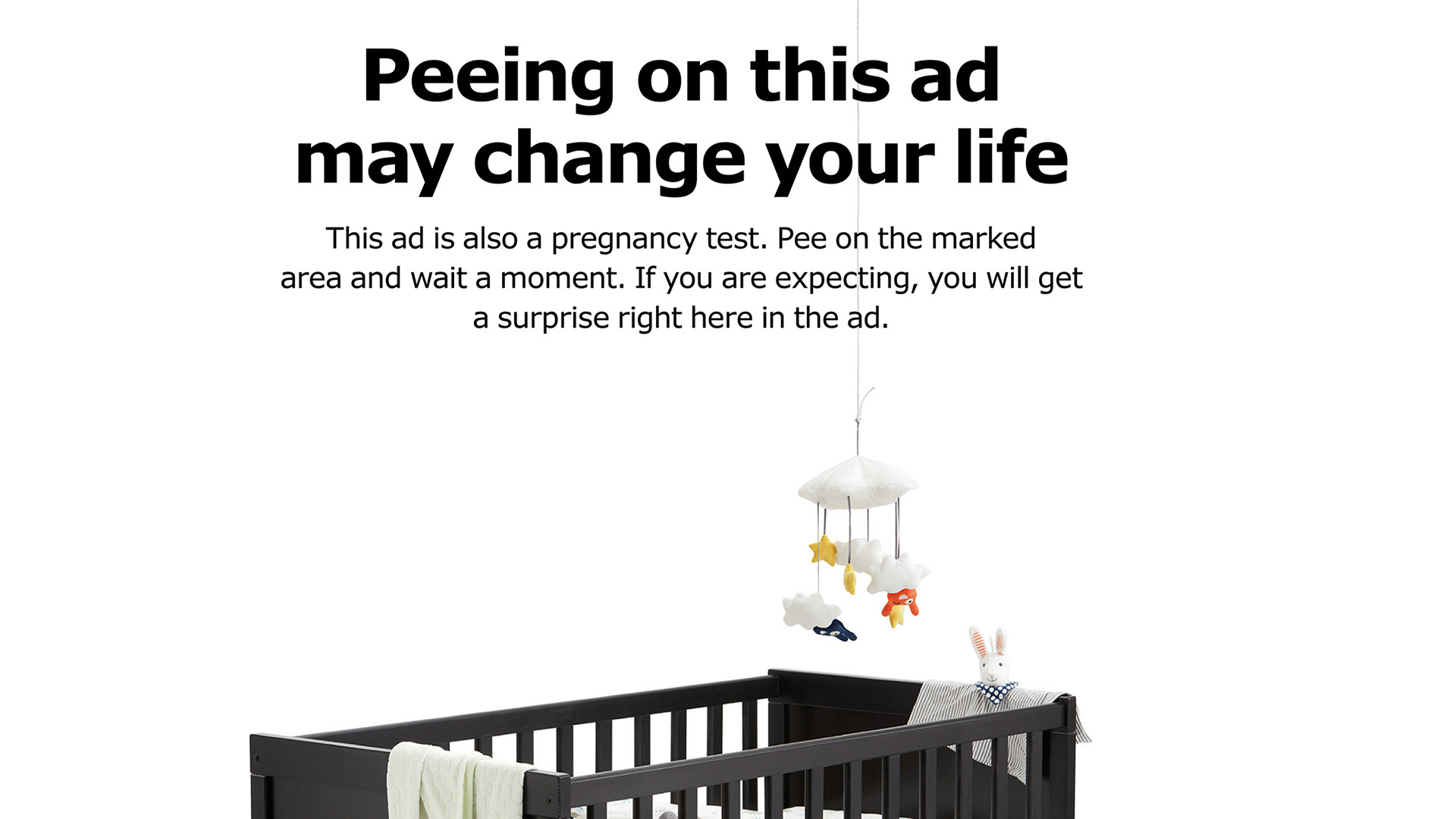
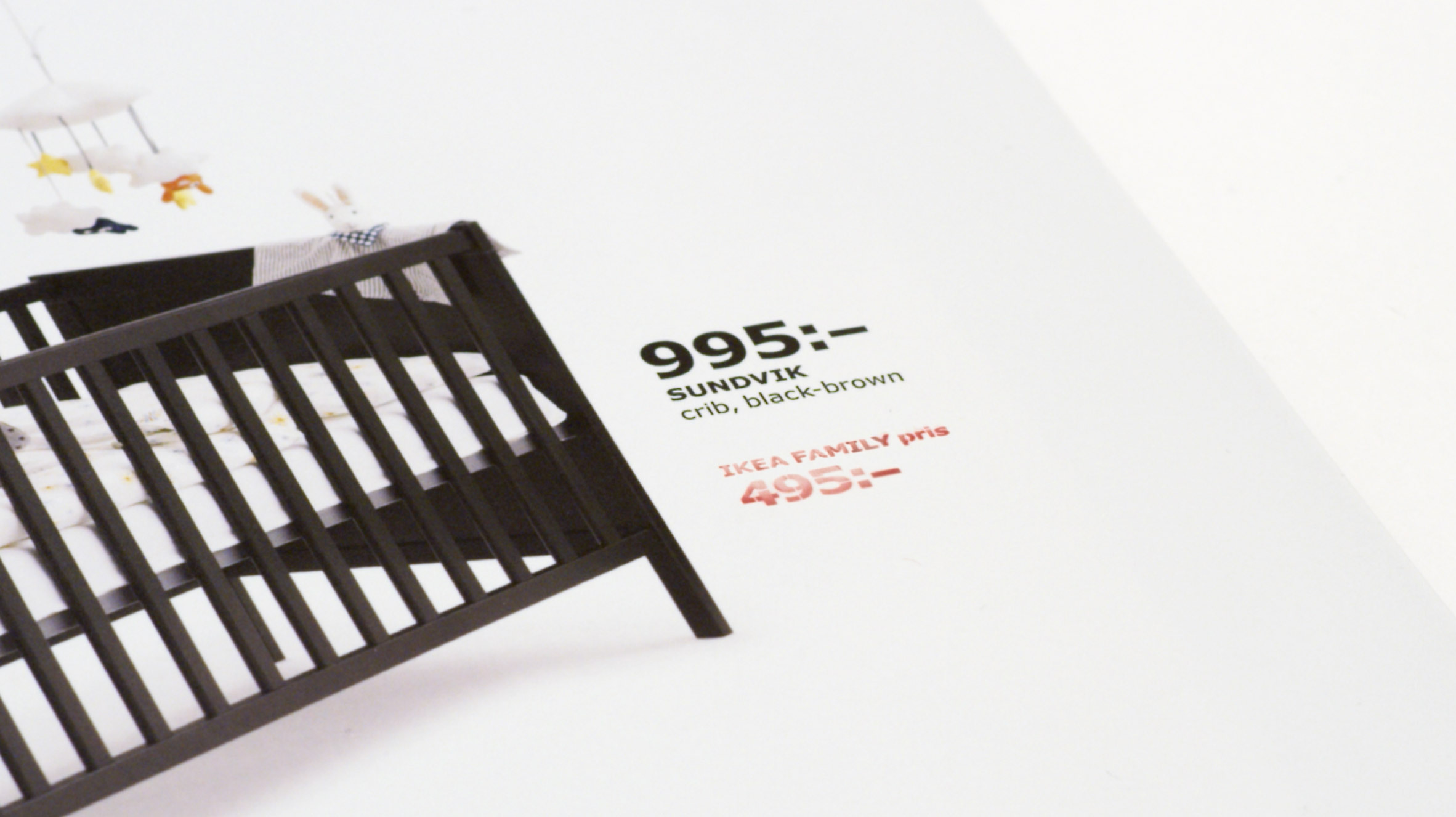
In the December 2017 issue of the Swedish women's magazine Amelia, IKEA Sweden, the Stockholm agency Åkestam Holst and the materials laboratory Mercene Labs ran a print advertisement that doubled as a working pregnancy test.1, 2 The page invited the reader to "pee on this", and the chemistry printed below the headline reacted with hCG, the hormone present in a pregnant person's urine, to reveal a discounted "family price" of 495 SEK on the IKEA Sundvik crib, down from the standard 995 SEK.2, 3 The advert appeared just before the end of the year and went viral globally in the first week of January 2018, reported as one of the most discussed pieces of print advertising of the decade.
The brief and the partners
The brief from IKEA Sweden was tactical in scope, an annual baby-and-children category communication for the Sundvik crib, but the agency's response moved the format. Åkestam Holst, the long-standing creative agency behind Where Life Happens for IKEA Sweden, proposed an advert in which the price information was visible only to the reader for whom the offer was relevant.2, 4 To execute that idea, the agency needed a way to detect a pregnancy on a printed magazine page without producing a separate kit or asking the reader to leave the page.
Mercene Labs, a Stockholm research laboratory specialised in functional surface coatings, took on the chemistry.2, 3 The team had four months to translate a clinical lateral-flow pregnancy test into a layout that could survive offset printing, magazine binding and consumer handling.2, 3 The starting point was the same antibody chemistry used in pharmacy pregnancy tests: a strip impregnated with antibodies that bound to hCG and produced a colour change.5 The challenge was to integrate the strip into a printed page, hide it under the existing artwork, and make it react cleanly enough to reveal the discounted price as a legible numeric value rather than as a generic positive line.
How the page worked
The reader saw a quiet image of the Sundvik crib with the headline "Peeing on this ad may change your life", a short brand line, and the standard 995 SEK price.3, 6 The instruction was deliberately direct: place the strip at the bottom of the page in a stream of urine, then wait. If the test detected hCG, a colour-change reaction inside the page revealed a second price strip, the family price of 495 SEK, behind the standard one.1, 3 If the test was negative, the page returned to its original layout with no offer revealed. The mechanism rewarded the reader for whom the discounted crib was relevant and asked nothing additional of any other reader.
The science was conventional but the substrate was not. Mercene Labs developed an absorbent paper layer that handled the urine volume, an antibody printing pattern that survived the printing process, and a colour reaction that was legible in domestic lighting. The page was bound into Amelia as a regular full-page advert with a small additional thickness. The four months of development produced a printable strip that worked at consumer scale.
The release and the viral reach
The advert appeared in the December 2017 issue of Amelia, with shelf life through the start of January 2018.1 The campaign moved to international media on 8 January 2018 when Åkestam Holst and IKEA released a behind-the-scenes film and stills to global trade outlets. The Drum, Adweek, Dezeen, The Guardian and Today.com all covered the story between 9 and 11 January 2018.2, 3, 5, 7 The Snopes fact-check confirming the advert's authenticity went live on 11 January, and the Washington Post, Newsweek and the BBC followed in the same week.6
The reaction was wide and divided. Trade press treated the work as an exemplary use of medium, a category-redefining moment in print advertising. Mainstream press treated the work as a curiosity that prompted a conversation about pregnancy, advertising and intimacy in domestic media. Across both registers, the advert performed exceptionally on share metrics. Åkestam Holst reported earned-media reach in the hundreds of millions of impressions over the first week of coverage. The advert was nominated at multiple awards, taking two Gold Lions in Print & Publishing and a Bronze Lion in Media at Cannes Lions in 2018 and recognition at the Eurobest and Spikes Asia award programmes.8
What it argued for the brand
The advert sat inside the longer Åkestam Holst editorial relationship with IKEA Sweden that began in 2016 with Where Life Happens.4, 8 The agency's argument across that platform was that IKEA's most credible advertising was the kind that observed real life closely rather than dramatised it. The pregnancy-test page took that argument to its logical edge. Real life included the moment a pregnancy was confirmed; the brand's response was to turn that moment into the reveal of a relevant offer rather than an unrelated emotional appeal.
For the wider industry, the work became a reference case for measurement-as-mechanic in print, the idea that an advert could carry a measurement instrument inside its substrate and reward the reader's interaction with relevant content. The page is still cited in trade-press long-reads on print innovation, and Mercene Labs continued to work on functional print substrates after the campaign. For IKEA, the campaign confirmed that the brand's editorial confidence in Sweden could extend from television to long-form film to a single magazine page that asked its reader for something the rest of the publication did not.
Source: Dezeen Youtube
Written with AI assistance, edited by a human. Find out more about our Use of AI.
1. LBBOnline, "The Story Behind the IKEA Ad that Asked Magazine Readers to Pee on It", 1 February 2018, for the advert having run in the December 2017 issue of the Swedish women's magazine Amelia, for its creation by Åkestam Holst for IKEA with the medical technology laboratory Mercene Labs, and for the mechanism by which a hidden price appeared below the pre-printed crib price when the embedded test detected a pregnancy. https://lbbonline.com/news/the-story-behind-the-ikea-ad-that-asked-magazine-readers-to-pee-on-it
2. Dezeen, Alice Morby, "Shoppers encouraged to urinate on IKEA's latest advert", 10 January 2018, for the advert as a working pregnancy test placed in a Swedish women's magazine by IKEA and the Stockholm agency Åkestam Holst with the materials research company Mercene Labs, for the hCG hormone triggering a colour change that revealed a discounted price on the crib, spelled Sundvick there, for the agency's statement that "Instead of a simple line indicating a positive result, IKEA presents you with a better price", for Mercene Labs' background in surface active materials for microfluidics and medical diagnostics, for the four months of development, and for Dezeen's own report of 10 January 2018. https://www.dezeen.com/2018/01/10/shoppers-encouraged-urinate-ikea-advert-akestam-holst-graphics/
3. Price and partner reporting. Today, "Ikea pregnant 'pee ad' for crib captures attention", undated on the page as retrieved on 25 September 2026, for the discounted "family price" becoming visible after a positive test, the regular crib price of 995 Swedish krona, Mercene Labs being based in Stockholm, the technology having taken Mercene Labs four months to develop, and Today's coverage of the story. https://www.today.com/parents/ikea-pregnant-pee-ad-crib-captures-attention-t121060 It's Nice That, Jenny Brewer, "Pee on this Ikea print ad, and if you're pregnant, you get a crib half price", 10 January 2018, off whitelist and used for corroboration only, for the magazine Amelia, the reduction from 995 SEK to 495 SEK on a positive result, and the headline "Peeing on this ad may change your life". https://www.itsnicethat.com/news/ikea-pregnancy-test-pee-print-advertising-100118 Wikipedia, "IKEA", retrieved 25 September 2026, for IKEA Family as IKEA's free loyalty card, used to obtain discounts on certain products. https://en.wikipedia.org/wiki/IKEA
4. IKEA Museum, "IKEA and advertising", undated, retrieved 25 September 2026, for Where Life Happens as an IKEA Sweden campaign by the agency Åkestam Holst NoA dated 2016 to 2017, developed to show how IKEA offers solutions in the everyday lives of the many people. https://ikeamuseum.com/en/explore/the-story-of-ikea/ikea-and-advertising/ Wikipedia, "Åkestam Holst", carried in the verse's source list for the agency; no English-language article could be retrieved, page not reachable on 25 September 2026. https://en.wikipedia.org/wiki/%C3%85kestam_Holst
5. The Drum, John Glenday, "Ikea offers crib discount to pregnant mums who pee on its ad", 10 January 2018, for the agency's account that the pregnancy test strip was used as a starting point, relying on antibodies that bind to the pregnancy hormone hCG and produce a colour change, and for The Drum's own report of 10 January 2018. https://www.thedrum.com/news/2018/01/10/ikea-offers-crib-discount-pregnant-mums-who-pee-its-ad
6. Snopes, Arturo Garcia, "Did IKEA Release an Advertisement Containing a Pregnancy Test?", 11 January 2018, for the fact-check rating the advert's existence true and its publication date of 11 January 2018, for the advert reading "Peeing on this ad may change your life", and for its appearance in what IKEA called a limited edition of Amelia. https://www.snopes.com/fact-check/ikea-pregnancy-test-ad/
7. Further January 2018 coverage. Adweek, Tim Nudd, "Why the Ikea Ad That You Pee on Is (Maybe) Not as Weird as You Thought", 11 January 2018, for Adweek's coverage of the advert on 11 January 2018; the article is behind a paywall and was read only in its public part. https://www.adweek.com/creativity/why-the-ikea-ad-that-you-pee-on-is-maybe-not-as-weird-as-you-thought/ The Guardian, report on the IKEA pregnancy test advert, 10 January 2018 by its URL, for The Guardian's coverage of the story; its title and text could not be checked, page not reachable on 25 September 2026. https://www.theguardian.com/business/2018/jan/10/ikea-invites-customers-to-pee-on-this-ad-to-check-for-pregnancy-and-a-crib-deal
8. Åkestam Holst, "A whopping 6 Lions in total to Åkestam Holst in Cannes 2018", 25 June 2018, for the Pee Ad winning Gold in Print (Retail), Gold in Print (Innovation) and Bronze in Media at Cannes Lions 2018. http://www.akestamholst.se/news/a-whopping-6-lions-in-tot/ Campaigns of the World, "IKEA turns a 2X2 Magazine ad into a medium for pregnancy tests! - IKEA Pee Ad", 7 July 2019, for the advert being part of IKEA Sweden's Where Life Happens platform and for its credits to Åkestam Holst NoA and Mercene Labs. https://campaignsoftheworld.com/creative-print-ads/ikea-pee-ad/