
A brand platform that filmed Sweden as it actually lived
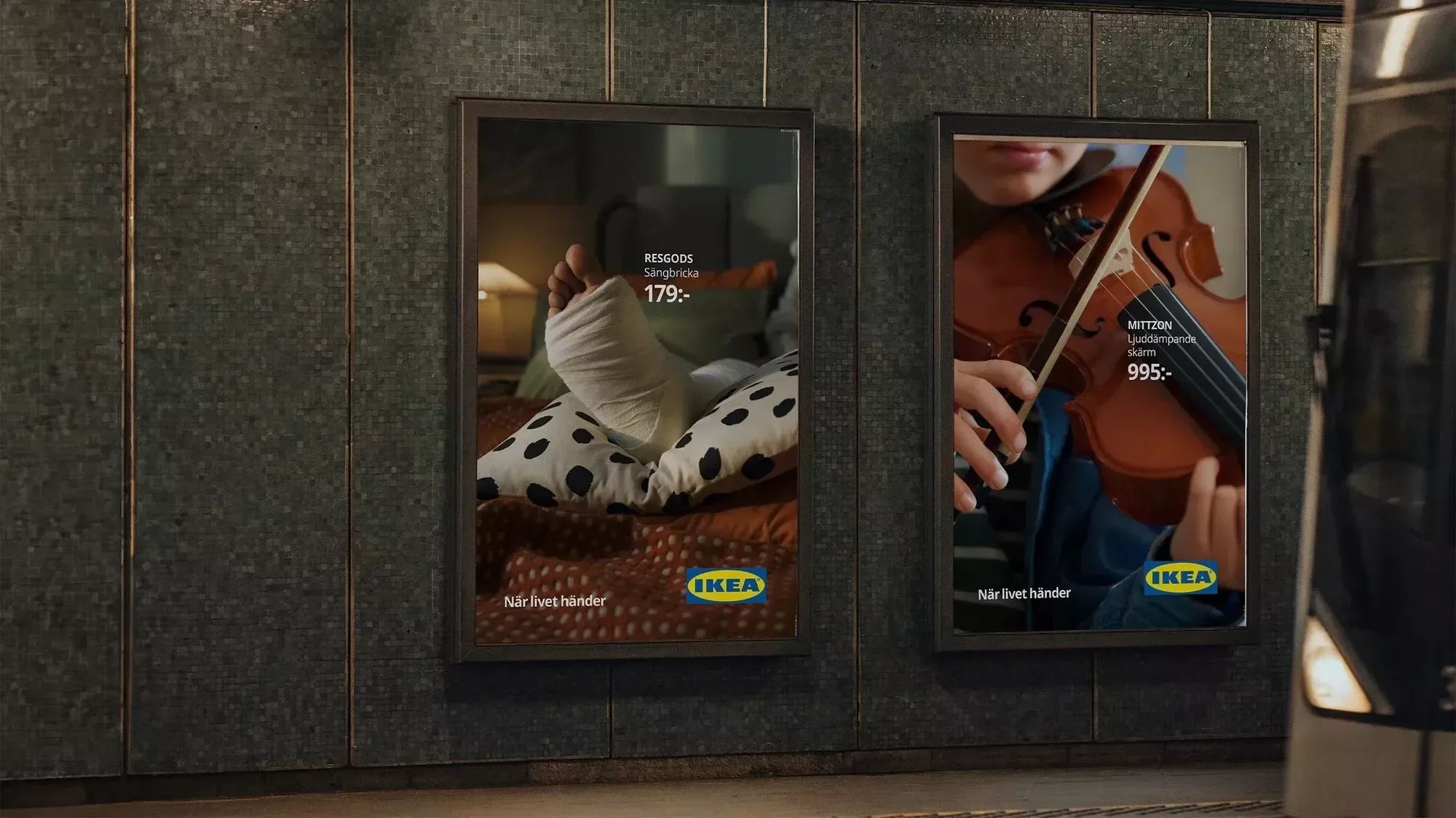
In September 2016, IKEA Sweden and the Stockholm agency Åkestam Holst launched a brand platform called Där livet händer, translated for international audiences as Where Life Happens.1, 2 The launch ran across television, cinema, print, outdoor, radio, online and social channels, and it set the editorial frame that IKEA Sweden's brand communication has worked inside ever since. The platform was built on a single mechanism: a recognisable IKEA price tag attached to a real, often complicated, domestic situation.
The first films were not product spots. They were short pieces of fiction grounded in everyday Swedish life. A divorced father carefully recreating his son's bedroom every other week.2, 3 A young couple finding a moment of calm before the arrival of a child. A flatshare changing shape as one tenant moved out and another moved in. The product was visible, the price was named, but the editorial subject was the household.
The strategic shift
IKEA Sweden's earlier marketing had largely operated as a steady stream of product-led promotion.1 The catalogue carried the bulk of the inspirational work, and broadcast advertising tended to amplify seasonal price points.4 Where Life Happens reframed the question. Rather than treating the brand as an inventory of objects with attractive prices, the platform treated IKEA as the company that already sat inside the country's everyday domestic reality.1, 5 The product range followed the household, not the other way around.
The price-tag mechanic was central to that reframe. In each film, the camera tracked a recognisable IKEA price tag through the scene, sometimes resting on a chair, sometimes on a lamp, sometimes on a bedside drawer that signalled what the room was about to become. The mechanic preserved the brand's commercial obligation, the price was always present, while leaving the narrative to do the editorial work.
The creative team and craft choices
The campaign was led on the agency side by art directors Jesper Holst and Michal Sitkiewicz, with copywriting from a wider Åkestam Holst team.3 Direction across the early films was anchored by Martin Werner at Bacon, with cinematography by Mattias Rudh.2, 3 The look was deliberately grounded. Light was natural where possible. Locations were real Swedish apartments rather than purpose-built sets. Casting favoured non-actors and lesser-known performers in order to keep the situations recognisable rather than aspirational.
Music and sound were used sparingly. The films relied on diegetic sound (the noise of cooking, of children playing, of a tap running) rather than on a brand soundtrack. The result was a body of work that read closer to short documentary than to retail advertising. Campaign and Ad Age both noted at the time that Where Life Happens traded the conventions of furniture marketing for the conventions of long-form film.
The first films
The platform's opening film, Every Other Week, depicted a divorced father preparing his son's room for the weeks the son spent with him.2, 3 The room was rebuilt each fortnight in the same configuration: bed, lamp, posters, soft toys. The price tags on each piece carried a quiet domestic weight that more conventional product advertising could not have produced. The film became one of the most-watched IKEA pieces of the decade in the Nordic markets.
The follow-up films extended the same editorial logic. The Cycle took on household recycling, encouraging people to keep sorting their glass, cans, plastic and cardboard even when it is a hassle.6 The Bedroom reframed an empty room as a future nursery. The campaign's subsequent waves covered weekend hosting, generational meetings, friend gatherings, and the ordinary mechanics of cohabitation.1 The IKEA range stayed visible throughout, but the camera always favoured the people in the room over the objects in it.
Source: The Last Marketer Youtube
Reception
The platform was widely covered in the international advertising press. WARC, Ad Age, Campaign and The Drum all profiled the work in the months after launch, treating it as a model for retail brand storytelling that resisted the gravitational pull of product spots. Awards followed, including festival shortlists at Cannes Lions and the Eurobest, and the platform became a frequent reference point in subsequent IKEA agency briefs across other markets.
Inside Sweden, the campaign also sustained itself commercially. IKEA Sweden has continued to release Where Life Happens films across the years that followed, and the agency relationship with Åkestam Holst NoA has produced further work inside the same editorial frame, including the brand's later forays into live media (private apartment windows used as out-of-home placements), and the May 2026 outdoor work FRAKTA Point-Of-You, which uses the same logic with a different mechanism.6, 7, 8
What the platform set up
The deeper effect of Where Life Happens was structural. The campaign established a brand frame that IKEA Sweden could keep extending without renegotiating its premise. The premise (everyday domestic life is the real subject of the brand) survives translation across formats: a film, a poster, an outdoor system, a print insert. The mechanism (the price tag inside the situation) anchors each new execution to the brand without demanding that the situation be flattened.
For Åkestam Holst, the platform was the foundation of a long working relationship with IKEA Sweden that has continued through the late 2010s and into the 2020s.7 The agency's later IKEA work tends to be read through the same editorial filter the platform set up in 2016. The brand's job, in this reading, is not to interrupt domestic life but to be visible inside it.
Source: Creative Broadcast Youtube
Written with AI assistance, edited by a human. Find out more about our Use of AI.
1. IKEA Museum, "IKEA and advertising" (served under the browser title "IKEA advertising through the ages"), undated, retrieved 25 September 2026, for "Där livet händer/Where life happens" as an ad campaign by IKEA Sweden and the Åkestam Holst NoA ad agency, dated there 2016 to 2017, for the concept having been "developed to emphasise how IKEA takes a natural place and offers solutions in the everyday lives of the many people", for the campaign showing everything from children moving between different parents following a divorce to rehearsing rock bands and meetings between generations, of which only the meetings between generations appear among the later subjects the body names (weekend hosting, friend gatherings and cohabitation are not in the source), and for the earlier, 1980s IKEA ads made by the Brindfors agency as "Full pages with a host of products with attractively low prices, always with a clear price tag". https://ikeamuseum.com/en/explore/the-story-of-ikea/ikea-and-advertising/
2. Launch reporting, September 2016. shots, "IKEA: Every Other Week", 14 September 2016, off whitelist and added during the retrofit, for the film as a campaign by the Stockholm agency Åkestam Holst, directed by Martin Werner at the production company Bacon with Mattias Rudh as director of photography, for its story of a young boy's first fortnightly visit to his father's newly furnished apartment, where his bedroom from his mother's home has been replicated, and for the film closing on the tagline "where life happens", which dates the platform's public launch to mid September 2016. https://shots.net/news/view/91155-ikea-every-other-week La Réclame, Anna L., "IKEA s'attaque au sujet tabou du divorce", 14 September 2016, off whitelist and used for corroboration only, for Every Other Week as the first of a series of eight films under the Where Life Happens campaign devised by Åkestam Holst, and for its boy moving between his mother's and his father's apartments. https://lareclame.fr/akestamholst-ikea-wherelifehappens-159457
3. Ads of the World, "IKEA: Every Other Week", October 2016, off whitelist and listed in the verse's sources, for the film by Åkestam Holst NoA, Stockholm, for its premise that living in two homes with divorced parents is a reality for many children in Sweden and that affordable products let the parents in the film ease the situation for the child, and for its credits: art directors Jesper Holst and Michal Sitkiewicz, copywriters Mark Ardelius and Rickard Beskow, creative director Magnus Jakobsson, director Martin Werner of Bacon and director of photography Mattias Rudh. These are the credits of the opening film; no source found gives the credits of the later films. https://www.adsoftheworld.com/campaigns/every-other-week
4. Wikipedia, "IKEA", retrieved 25 September 2026, for the catalogue having been considered the company's main marketing tool, consuming 70 percent of its annual marketing budget. The source says nothing about broadcast advertising and seasonal price points. https://en.wikipedia.org/wiki/IKEA
5. WARC, "How IKEA becomes a part of every life situation", 1 February 2018, for its framing of IKEA as a part of every life situation. The article body sits behind WARC's paywall; on 25 September 2026 only the headline, the date and the standfirst, which presents IKEA as a symbol of Swedish utility following the vision of its founder Ingvar Kamprad, were retrievable, so the article's own account of the platform could not be checked. https://www.warc.com/newsandopinion/news/how-ikea-becomes-a-part-of-every-life-situation/en-gb/39968
6. Åkestam Holst NoA, case page "Where Life Happens, The Cycle", undated, retrieved 25 September 2026, for The Cycle as a film within the Where Life Happens concept in which IKEA wants to inspire people in Sweden to keep recycling their glass, cans, plastic and cardboard even though it can be a hassle, and for the agency calling it the latest film within the concept, which shows IKEA Sweden still releasing Where Life Happens films after 2016. The page gives no release date. https://www.akestamholst.se/case/where-life-happens-the-cycle/
7. The 2025 campaign Wherever Life Goes. Creative Review, Daniel Milroy Maher, "Ikea lets its price tags tell the story in clever new campaign", 27 October 2025, added during the retrofit, for Åkestam Holst's continuing work for IKEA on the Swedish market in 2025, a campaign of five short films built on the communication platform Wherever Life Goes. https://www.creativereview.co.uk/ikea-lets-its-price-tags-tell-the-story-in-clever-new-campaign/ Ad Age, "Ikea Sweden's poetic new campaign lets the price tags do the talking", October 2025, listed in the verse's sources, for the same 2025 campaign, not for the 2016 launch; on 25 September 2026 the address served only Ad Age's front content and no article body, so its title is taken from the search index and its text was not checked. https://adage.com/creativity/work/aa-ikea-sweden-wherever-life-goes/ GoSee, news item 68229, "'Wherever Life Goes' campaign for IKEA Sweden by Åkestam Holst NoA", undated, off whitelist and listed in the verse's sources, for IKEA introducing with the Stockholm agency Åkestam Holst its first new communication concept since 2016, described as an evolution of the storytelling style that has long defined IKEA's communication, which carries the agency relationship and the platform's editorial frame into the 2020s. https://gosee.de/image/-wherever-life-goes-campaign-for-ikea-sweden-by-akestam-holst-noa-1461928/news/68229/newscategorie/113 GoSee, "Creatives to Watch: Eva Wallmark, Art Director & Partner at Åkestam Holst, on her new IKEA campaign WHEN LIFE HAPPENS", the interview part of the same news item, listed in the verse's sources for the art director's intent; the address served only a GoSee login form, page not reachable on 25 September 2026. https://www.gosee.news/news/creatives%20to%20watch/creatives-to-watch-eva-wallmark-art-director-partner-at-akestam-holst-on-her-new-ikea-campaign-when-life-happens-68229
8. Famous Campaigns, James Herring, "IKEA Sweden's new campaign sees the world from the bottom of a bag", 7 May 2026, off whitelist and added during the retrofit, for FRAKTA Point-Of-You as an out-of-home campaign for IKEA Sweden by the Stockholm agency Åkestam Holst NoA, reported in May 2026, which shoots everyday life through the open top of the blue FRAKTA bag. https://www.famouscampaigns.com/2026/05/ikea-swedens-new-campaign-sees-the-world-from-the-bottom-of-a-bag/