
One date, three companies, one word
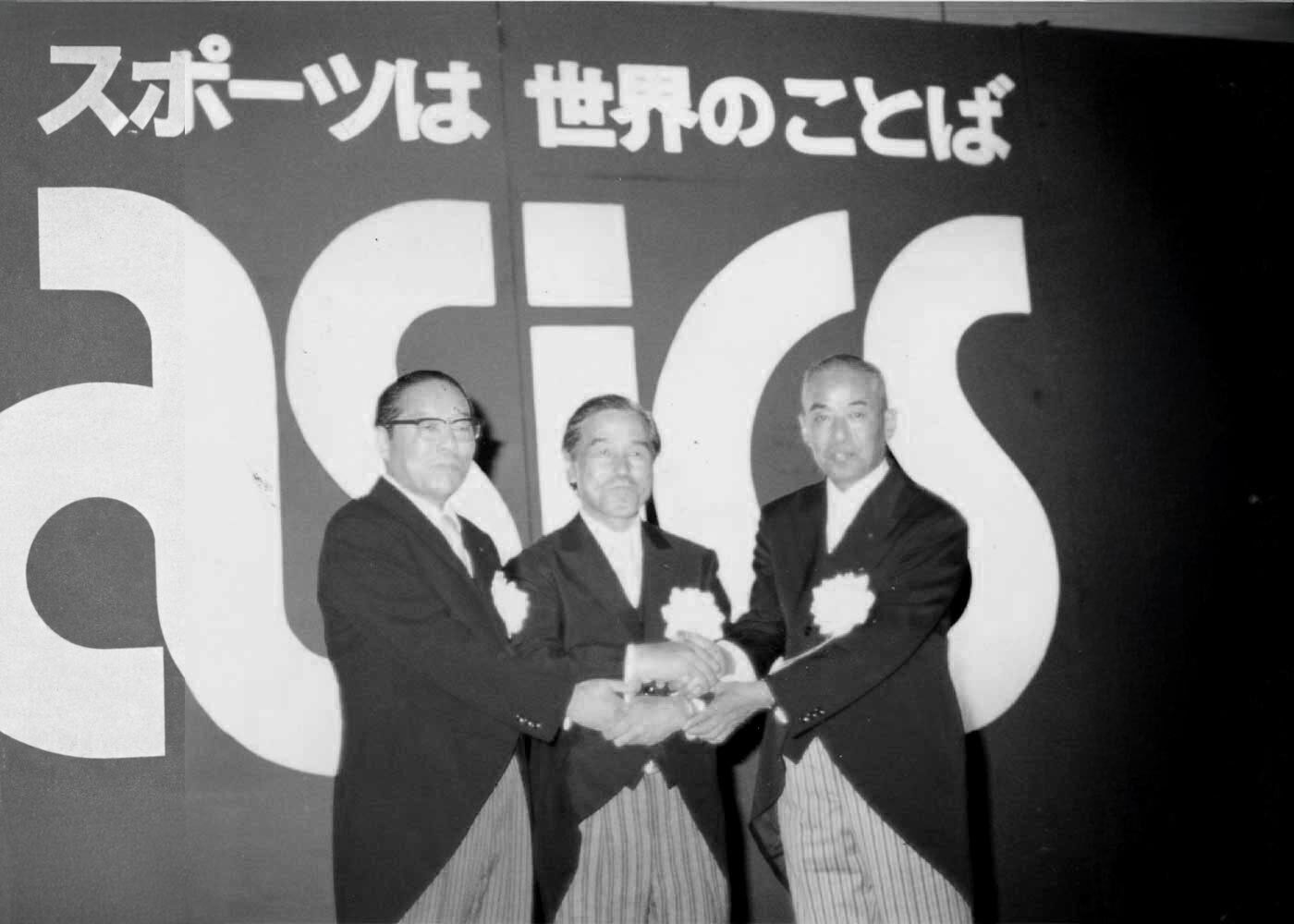
ASICS Corporation's own annual securities report fixes the moment precisely. With effect from 21 July 1977, Onitsuka Co., Ltd. changed its trade name to ASICS Corporation and merged with GTO Co., Ltd. and JELENK Co., Ltd. on the same date.1 The mechanism matters: this was not a new holding company placed above three businesses. Onitsuka was the surviving entity. It renamed itself and absorbed the other two in one step.
ASICS describes the transaction differently on its public history page, as three companies that "merge as equals to form 'ASICS Corporation'".2 Both statements are the company's own, and the difference between the legal and the published account is the ordinary gap between a filing and a brand story.
What the three companies were
Onitsuka Co., Ltd. had been founded in Kobe in September 1949 by Kihachiro Onitsuka and made sports shoes. ASICS' Japanese filing describes GTO as a sportswear and equipment maker and JELENK as a sportswear maker.1 The English language company history literature, and Wikipedia after it, describes GTO instead as a fishing and sporting goods company.3 The two descriptions circulate side by side and ASICS has not reconciled them.
What the merger did to the brand estate is clearer. The name Onitsuka Tiger was retired at this point, and the brand's own history page records the withdrawal as temporary.4 The crossed stripe introduced in 1966 did not go with it. It moved onto ASICS footwear and stayed there.
The sentence, and the word that is not in it
ASICS states that the name "is the initial letters of the phrase 'Anima Sana In Corpore Sano' by the ancient Roman satirist Juvenal" and translates it as "(If you pray to God, you should pray for) a sound mind in a sound body".2
Juvenal did not write that phrase. The line in Satire X reads "orandum est ut sit mens sana in corpore sano".5 The Latin word is mens, mind. Anima, soul or breath, is a substitution. It is also the substitution that makes the name possible: the initials of the sentence as Juvenal wrote it spell MSICS.
ASICS has never publicly addressed the change. The company presents the anima version as Juvenal's own words, on its history page and on its intellectual property page, without qualification, and no executive is on the record anywhere explaining the choice. The naming decision has held for nearly fifty years without a published account of how it was taken.
An acronym as a corporate name
The company it replaced had carried its founder's name. ASICS is a five-letter construction with no meaning in Japanese, no meaning in English and a meaning in Latin that few readers would recognise. The company established a slogan at the same time, "Sport: the Universal Language".2
The wordmark followed the name. ASICS states that the first logo was created in 1977 by Herb Lubalin, the New York typographer.6 The corporate identity programme around the new company was run by the Japanese consultancy PAOS, which brought Lubalin in, working with Alan Peckolick.7 A Kobe shoemaker of 1977 had assembled a Japanese merger, a Latin acronym and an American lettering designer.
The mark has been revised three times since, and ASICS publishes the reasoning for each. In 1987, at the company's tenth anniversary, the wordmark moved from bold to thin. In 1992 a new promotional logo was built from a stylised letter a, the mark now known as the ASICS Spiral. In 2007 the wordmark was updated again, in the company's own words, to improve visibility; that version is the one in use today.6 Through all of it the five letters have not changed, because they cannot: they are a sentence.
The company still publishes the sentence today, on the page it heads ASICS Spirit, under the heading Founding Philosophy, worded "Anima Sana In Corporre Sano - A Sound Mind In A Sound Body".8 The double r in Corporre is ASICS' own; the company spells it Corpore everywhere else on the same domain. A sentence that has been the corporate name for nearly five decades carries a typographical error on the page that explains it.
What the name became later
For most of the following three decades the Latin sentence sat in the founding story rather than in the marketing. That changed twice: in 2007, when the translation became the corporate slogan, and in January 2021, when the company rebuilt its marketing around the idea and attached commissioned research to it.2
Almost fifty years after the merger the acronym is what the company says it is for. The sentence behind it is still not the one Juvenal wrote.
Written with AI assistance, edited by a human. Find out more about our Use of AI.
1. ASICS Corporation, annual securities report, 72nd fiscal term, history section, for the merger effective date of 21 July 1977, the change of trade name, the absorption of GTO Co., Ltd. and JELENK Co., Ltd., the description of the two as a sportswear and equipment maker and a sportswear maker, and the founding of Onitsuka Co., Ltd. in Kobe in September 1949. Original wording: "1977年7月21日を合併期日として、商号を株式会社アシックスに変更し、スポーツウエア・用具メーカーの株式会社ジィティオ及びスポーツウエアメーカーのジェレンク株式会社と合併". https://assets.asics.com/system/libraries/4148/
2. ASICS Corporation, corporate history, for the published account of three companies merging as equals, for the statement that the name is the initial letters of "Anima Sana In Corpore Sano" attributed to Juvenal and its translation, for the slogan "Sport: the Universal Language" established in 1977, and for the adoption of "Sound Mind, Sound Body" as the corporate slogan in 2007. https://corp.asics.com/en/about_asics/history
3. Wikipedia, "Asics", for the English language description of GTO as a fishing and sporting goods company, which conflicts with ASICS' own Japanese filing. https://en.wikipedia.org/wiki/Asics
4. Onitsuka Tiger, official brand history, for the statement "In 1977, the company name changed and the brand temporarily disappeared" and for the stripe continuing on both ASICS and Onitsuka Tiger footwear. https://www.onitsukatiger.com/us/en-us/brand/history
5. Wikipedia, "Mens sana in corpore sano", for Juvenal, Satire X, "orandum est ut sit mens sana in corpore sano", and for the anima form being a variant. https://en.wikipedia.org/wiki/Mens_sana_in_corpore_sano
6. ASICS Corporation, "Brand and Trademark", for the statement that the first logo was created in 1977 by Herb Lubalin, and for the subsequent revisions in 1987, 1992 and 2007. https://corp.asics.com/en/focus/ip/brand
8. ASICS Corporation, "ASICS Spirit", for the Founding Philosophy as published, worded "Anima Sana In Corporre Sano - A Sound Mind In A Sound Body", and for the Vision, Philosophy and Values blocks on the same page. The spelling "Corporre" is as published. https://corp.asics.com/en/about_asics/spirit
7. Logo Histories, Richard Baird, "The ASICS logo story", 9 November 2023, off whitelist and used for corroboration only, for the corporate identity programme being run by PAOS and for Alan Peckolick working with Herb Lubalin on the logotype. https://www.logohistories.com/p/the-asics-logo-story