The hundred year jubilee bear
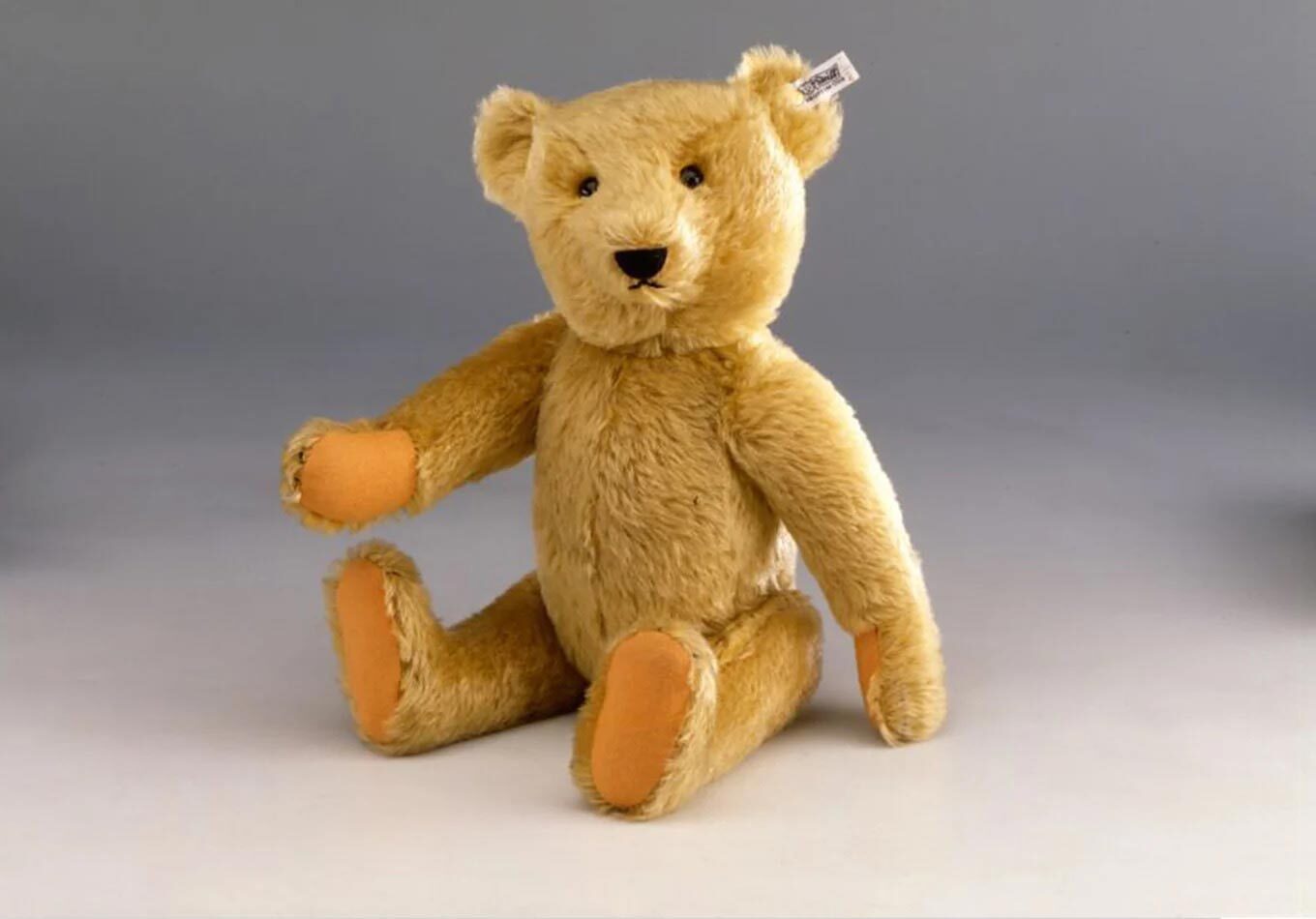
In 1980 Steiff celebrated its 100th anniversary with the release of a limited edition mohair bear known internally as the Jubilee Bear and to collectors as the Papa Bear. The figure was modelled on Richard Steiff's early jointed bears of the 1900s, with the same body proportions, the same long muzzle and the same flat foot pads that had defined the original Bear 55 PB at the 1903 Leipzig Spring Toy Fair. The bear was produced in a strictly limited run of 11,000 units, divided between 6,000 pieces with a German language certificate and 5,000 pieces with an English language certificate for the North American market.
The hand signed certificate
Each of the 11,000 certificates was hand signed by Hans-Otto Steiff, the great nephew of the founder Margarete Steiff and the last member of the founding family to lead the company before its transfer to professional management later in the 1980s. The decision to hand sign every certificate was unusual at the volume in question. A single individual signing 11,000 certificates by hand requires several months of dedicated work, and the certificates were prepared, signed and bound to the corresponding bears across the late 1979 and early 1980 period.
From 1981 onward all signatures on Steiff limited edition certificates were reproduced as printed facsimiles, which made the 1980 Papa Bear the only fully hand signed series in the brand's modern collector history. The fact has become one of the defining provenance markers in the Steiff secondary market, and collectors continue to verify Papa Bear authenticity primarily through the hand signed certificate rather than through the bear itself.
Why the launch mattered as a brand move
The 1980 Papa Bear was not the first Steiff limited edition. The white tag with red lettering system, introduced in 1953 for the Jackie Jubilee Bear at the 50th anniversary of the Bear 55 PB, had carried earlier commemorative releases. The 1980 launch nevertheless marked a structural shift. It formalised the Replica programme as a permanent commercial segment of the Steiff catalogue, rather than as an occasional anniversary release tied to a specific year. The programme would, from 1980 onward, produce a continuous flow of archive replicas that drew on the company's historical catalogue and recreated earlier designs at the original construction standard.
The strategic logic of the Replica programme addressed a specific problem for Steiff. The brand was, by 1980, competing in a global toy market in which mass produced plush at much lower price points had compressed the standard catalogue's margins. The Replica programme created a parallel commercial track that did not compete on price. It instead competed on provenance, scarcity and craft, and it monetised the company's own historical archive in a way that the standard catalogue could not.
The collector category
The 1980 launch also coincided with the early formation of the international plush toy collector market. Adult collectors had purchased Steiff animals on the secondary market through the 1960s and the 1970s, primarily through specialist toy auctioneers in London, New York and Berlin, but the segment had operated outside the company's direct control. The Replica programme brought the collector segment inside the company. A buyer who wanted to acquire a Richard Steiff style jointed bear could now do so through the official Steiff channel, with a Steiff certificate and a Steiff guarantee, rather than only through the secondary market.
Sotheby's London held the first dedicated Steiff teddy bear auction in 1989, with the 1980 Papa Bear setting an early benchmark for collector pricing on a modern limited edition. The auction confirmed that Steiff replicas had developed a working secondary market with documented price discovery, which in turn supported the primary market for subsequent releases. The Replica programme expanded through the 1980s and 1990s with additional anniversary editions, archive recreations of early 1900s designs and country specific releases that tied to particular national markets.
The brand consequence
The 1980 Papa Bear performed three functions for the Steiff brand. It celebrated the 100th anniversary at a register that matched the company's historical seriousness rather than at the lighter register of a mass market commemorative product. It formalised the Replica programme as a permanent commercial segment and gave the company a structured way to operate inside the collector market. And it confirmed the broader brand positioning that Steiff had developed through the twentieth century, in which the teddy bear was treated as a serious cultural object rather than as a disposable toy.
The Replica programme remains a primary commercial track for the company more than four decades after the Papa Bear launch. The Steiff e commerce platform and the collector dealer network continue to release new replica editions on a regular schedule, drawing on the historical archive at the Giengen factory and on the archive now displayed at the World of Steiff museum. The 1980 launch is the reference point for the entire arrangement and remains the most widely cited single edition in the secondary market record.
Hans-Otto Steiff died in 2006. The hand signed Papa Bear certificates have, since his death, become the only surviving artefacts of a manual brand signature that the company has not repeated since 1980. The certificates are themselves now valued by collectors as documents in addition to their function as provenance markers for the corresponding bears.
Written with AI assistance, edited by a human. Find out more about our Use of AI.