German premium plush toy manufacturer recognized as the inventor of the teddy bear and the steward of the Knopf im Ohr trademark, with a guiding princ…
12 Articles
Founded in 1854 by Louis Vuitton in Paris, Louis Vuitton Malletier is one of the world's most valuable luxury houses and the largest revenue contribut…
14 ArticlesThe bear that broke the auction ceiling
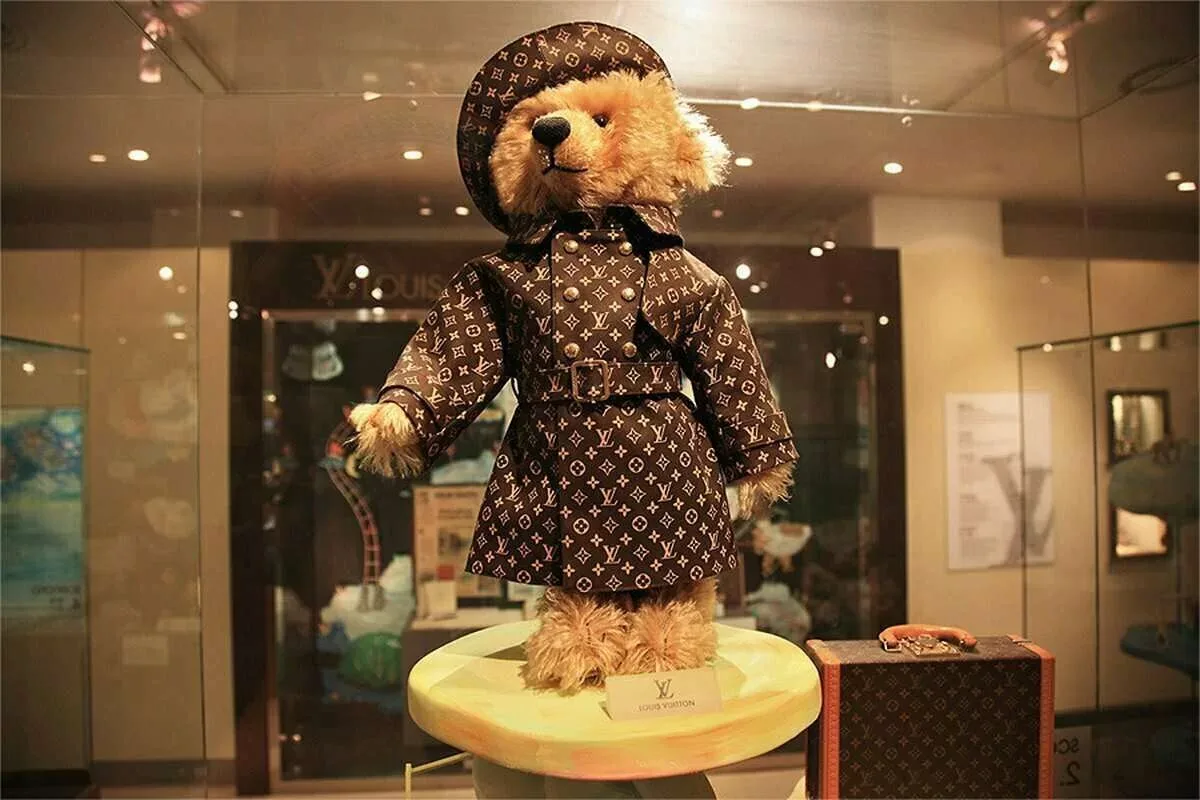
On 14 October 2000 a charity auction in Monaco sold a Steiff teddy bear dressed by Louis Vuitton for 130,190 pounds sterling, roughly 182,000 US dollars at the prevailing rate. The price set the Guinness World Record for the most expensive teddy bear ever sold, a record the bear still holds. The buyer was the Korean collector Jesse Kim, who placed the figure in the Teddy Bear Museum on Jeju Island, South Korea, where it remains on display. The Steiff Louis Vuitton bear therefore performs two roles in branding history at once. It is the highest priced teddy bear in the world and it is also the moment that confirmed the licensing logic Steiff had been building since the 1931 Disney agreement.
Les Teddies de l'an 2000
The auction was titled Les Teddies de l'an 2000 and was organised as a millennium charity event in the Principality of Monaco. The mechanic placed Steiff at the centre of the staging. The German manufacturer produced a small edition of an unnamed teddy figure called U Pitchnoun and supplied it to 41 luxury houses, who each redressed and decorated one bear in their own brand language. The line up included Louis Vuitton, Hermès, Cartier, Bulgari, Chaumet and other Place Vendôme and Avenue Montaigne names. The 41 finished bears were auctioned for charity over a single evening. The arrangement therefore made Steiff the canvas and a constellation of luxury maisons the brushes, with the auction price marking each house's standing on the night.
The Louis Vuitton specification
Louis Vuitton's bear arrived as the headline lot. The figure wore a coat printed in the Monogram pattern, carried a miniature LV trunk on a strap, and stood approximately fifty centimetres tall in honey mohair. The eyes were set with sapphires and small diamonds, the muzzle was stitched with gold thread, and the leather trim of the trunk and belt carried the monogram canvas in miniature. Contemporary collector accounts describe the construction as a one-to-one translation of the Louis Vuitton archive into bear scale, with the Vuitton workshop supplying the leather goods and the Steiff workshop supplying the bear. The combined object therefore carried both trademark signatures, the Knopf im Ohr on the left ear and the LV monogram on the trunk and coat.
The price as a brand statement
The 130,190 pound result eclipsed the previous teddy bear auction record, which Christie's South Kensington had set in 1994 with the antique Steiff Teddy Girl at 110,000 pounds. The earlier record had rested on age, provenance and condition, the standard variables of antique trade. The Vuitton record rested on a different combination, namely current production, dual trademark signatures and the publicity weight of a millennium charity night attended by the international luxury press. The auction therefore established that a contemporary Steiff figure produced for a single evening could command an antique level price if the wardrobe came from the right house and the staging was right. The principle that secondary market value can be engineered at the moment of release, rather than emerging slowly over decades, dates from this auction night in branding terms.
The Jeju afterlife
Jesse Kim's acquisition routed the bear into a museum context rather than into a private collection. The Teddy Bear Museum on Jeju Island opened in 2001 and uses the Louis Vuitton bear as one of its anchor exhibits, alongside other Steiff record items and an extensive replica collection. The museum framing did two things for the brand. It made the bear permanently accessible to the public, which created a continuing visit driver for collectors and tourists, and it removed the figure from any future resale cycle, which preserved the 2000 price as a closed historical record rather than a benchmark that could be revisited at auction. The combination is the reason the Guinness entry has remained stable since.
The brand architecture
The Monaco auction sat inside a longer architecture. Steiff had been producing co branded figures since the 1931 Mickey Mouse agreement, and the 1953 ear tag colour system gave the company a trademark grammar that could differentiate regular catalogue pieces from limited editions and replicas. The Vuitton collaboration extended that grammar into the luxury house category for the first time at headline price level. The figure carried the Knopf im Ohr trademark, the white ear tag identifying it as a limited edition release and the Louis Vuitton monogram applied to its wardrobe and accessories. The architecture therefore allowed the bear to be a Steiff product and a Louis Vuitton product at the same time, without contradiction at the trademark layer.
The brand consequence
The Louis Vuitton record reset the ceiling for what a contemporary Steiff figure could command. The pattern it established, namely Steiff as the manufacturing constant and a luxury or fashion house as the wardrobe variable, supplied the template for everything that followed in the brand's licensing programme. The 2008 Karl Lagerfeld bear at Colette applied the template to a designer portrait. The HUGO BOSS holiday capsule of 2025 applied it to a seasonal fashion calendar. In each case the Steiff trademark remained intact and the partner brand contributed the dress and the merchandising platform. The 2000 Monaco bear is therefore not only a record holder. It is the originating reference point for the entire premium Steiff crossover category as the brand still operates it a quarter of a century later.
Written with AI assistance, edited by a human. Find out more about our Use of AI.