
200 rabbits, three weeks, two and a half tonnes of clay
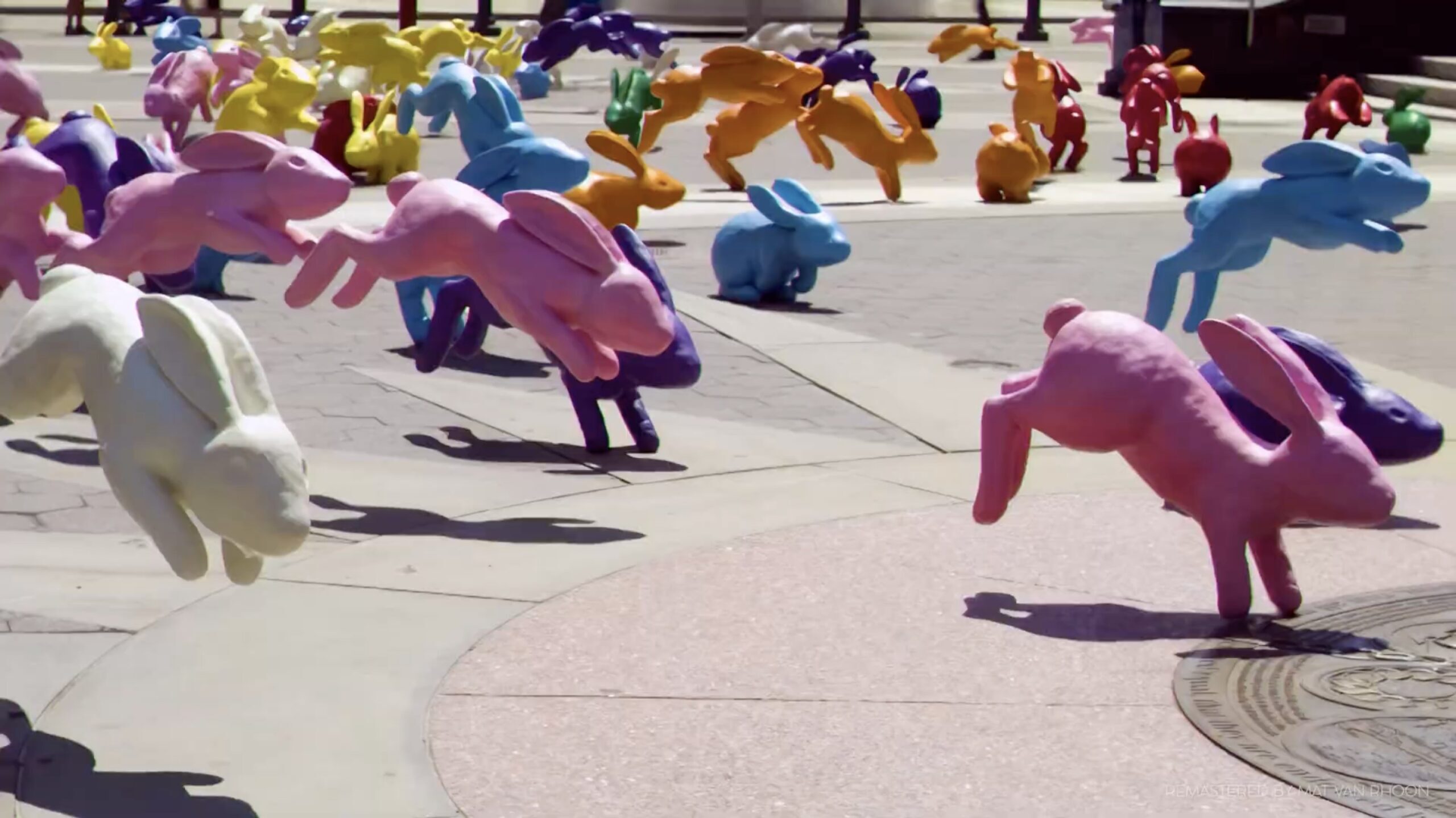
On 13 April 2008, Sony released Play-Doh, the third platform film in the Bravia television campaign by Fallon London. The 60 second commercial was directed by Frank Budgen and Darren Walsh and produced by Passion Pictures for Fallon. It premiered on UK broadcast and cinema and was rolled out internationally over the following weeks. Play-Doh closed the trilogy that began with Balls in 2005 and continued with Paint in 2006, and it carried the same platform line: Colour Like No Other.
The film populated a New York City street with a cast of brightly coloured Play-Doh rabbits hopping, bouncing, and assembling into larger forms. Trade reporting and the British Animation Awards confirmed the production scale: 189 two-foot bunnies, 150 one-foot cubes, a 30-foot giant rabbit, and a 10-foot by 20-foot purple wave, modelled in roughly two and a half tonnes of clay over a three-week shoot in New York. The crew of around 40 animators worked at frame-by-frame stop motion in real urban locations, then composited the figures with ambient city footage in post.
The platform argument carried over from Balls and Paint
Bravia had been the corporate Sony television set sub-brand since 2005, and Fallon had been responsible for its global brand work since the start of that platform. The trilogy of films, Balls in 2005, Paint in 2006, and Play-Doh in 2008, was designed as a sustained argument about a single product attribute, the Colour Like No Other proposition that named the Bravia Trinitron-derived colour engine. Each film took a different physical material, set it in a real city, and let the material's own properties demonstrate the proposition without product imagery, voiceover, or stated claims.
Balls had used 250,000 rubber bouncy balls cascading down the hills of San Francisco. Paint had used 70,000 litres of coloured paint detonated across the demolition of a Glasgow tower block. Play-Doh extended the device to stop-motion clay, which gave the film a different texture from its predecessors. Where Balls had been kinetic and Paint had been explosive, Play-Doh was rhythmic and tactile. The platform argument across the three films was that real colour, in real materials, in real environments, was the visual evidence the Bravia category needed.
Why Fallon kept the platform alive for three years
The decision to extend the Colour Like No Other platform across three discrete productions reflected the strategic position Sony was holding in the television market. Between 2005 and 2008, the LCD television category was moving rapidly through generations, prices were falling, and competing brands were spending heavily on technical specification claims. Sony's brand argument had to remain distinguishable across that cycle. The Fallon platform answered the technical noise with a sustained proposition about colour that did not need to be re-argued at each launch. Each new film extended the platform by changing the material, and each new material refreshed the visual argument without abandoning the line.
The financial commitment behind the trilogy was significant. Trade reporting at the time placed each film in the multi-million-pound production tier, and the campaign supported Bravia from its category entry through to a position as one of the leading premium television brands in Europe. The trilogy received heavy industry recognition. Balls had won Cannes Film Grand Prix in 2006. Paint had won D&AD recognition and Campaign of the Year 2006. Play-Doh continued the awards trajectory through the British Animation Awards and the international advertising circuit during 2008 and 2009.
The production and the director pairing
Frank Budgen had already directed Paint in 2006, and his return for Play-Doh paired him with stop-motion specialist Darren Walsh. Walsh, who had worked on Aardman productions including Wallace and Gromit and Creature Comforts, brought the technical experience needed for a stop-motion shoot at the scale Fallon was asking for. The Fallon creative direction was led by Juan Cabral, who had also led the platform from the start, and the production was handled by Passion Pictures in London with on-location work in New York.
The decision to use Play-Doh as the material was deliberate. The brand of modelling clay carries cultural memory of childhood play in the Western advertising audience and gave the film an emotional warmth that the kinetic Balls and the spectacle of Paint could not access in the same way. The selection moved the platform from physics to texture and gave the trilogy a rounded emotional arc. Balls was about delight, Paint was about awe, Play-Doh was about play itself.
What the trilogy continues to model
The Bravia trilogy is a useful reference for any brand maintaining a single visual platform across multiple flights. It demonstrated that a colour proposition can be argued without product imagery for three consecutive years, that practical production can outperform digital effects in audience attention, and that a sustained platform line can carry a category brand through a difficult retail cycle. It also demonstrated, in the broader pattern of Sony advertising in the period, that Sony's strongest brand work used the simplest possible proposition and gave it the most generous possible production. Play-Doh closed the trilogy on the same proposition that Balls had opened it with three years earlier, and the consistency of that proposition was the brand asset.
Source: Mat Van Rhoon VFX Youtube
Written with AI assistance, edited by a human. Find out more about our Use of AI.