
Colour, in 250,000 individual pieces
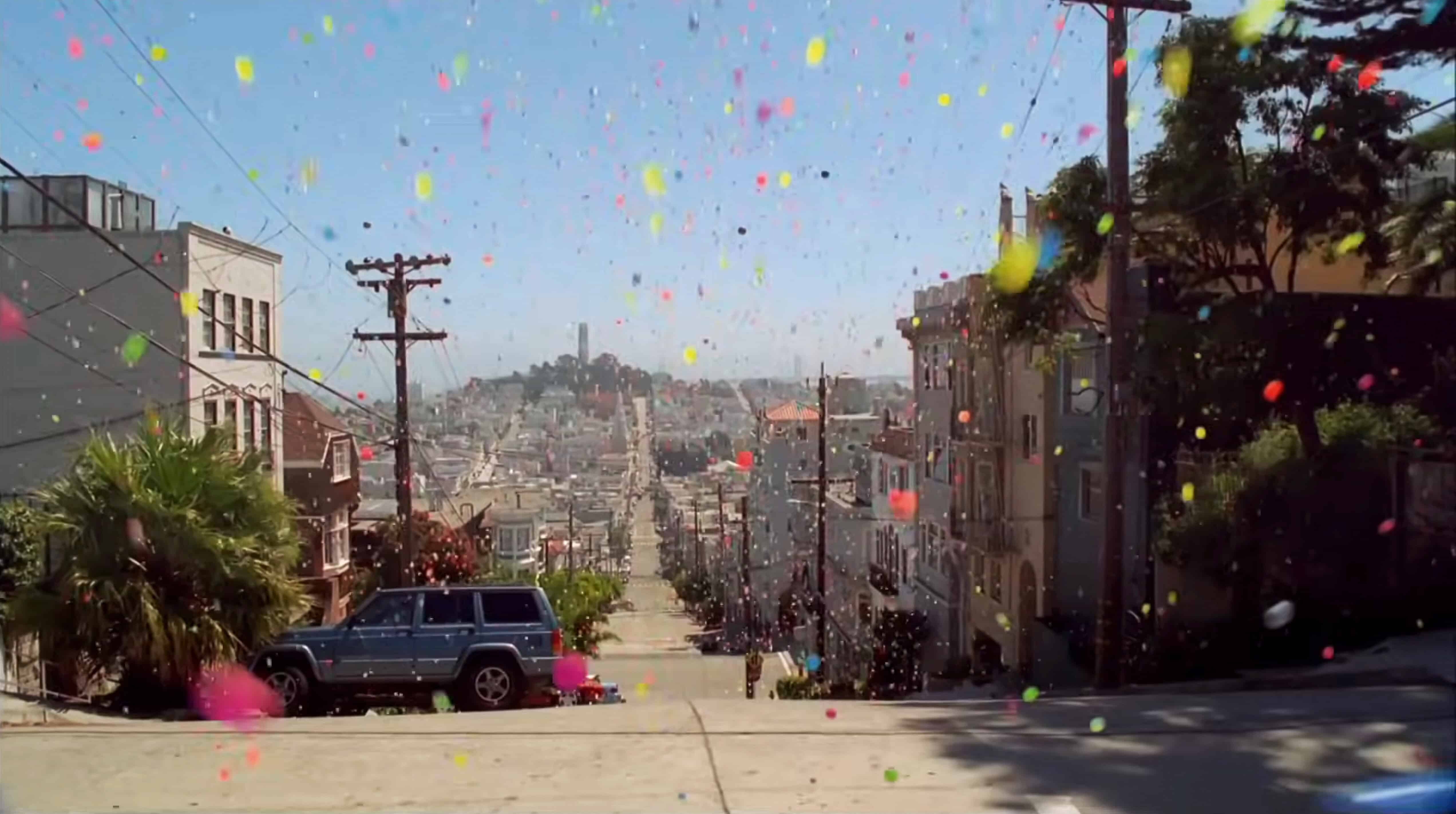
On 6 November 2005, Sony's Balls advertisement made its broadcast premiere on British television ahead of a Premier League fixture. The film, two and a half minutes long, showed 250,000 multicoloured rubber balls cascading down the steep streets of San Francisco, set to José González's "Heartbeats", a quiet acoustic cover of a Knife song. It carried the new product line tagline, "Colour, like no other". The campaign launched Sony's Bravia LCD television range across Europe.
The work was created by Fallon London, with art director Juan Cabral leading the concept. Cabral had been searching for a way to dramatise the Bravia panel's expanded colour gamut without ever showing the product. His pitch was a literal rendering of the abstract idea of colour, propelled through real physical space. Director Nicolai Fuglsig of MJZ shot the spot over four days using six cameras, including a high-speed Photosonic. There were no visual effects. Every ball in the final cut was launched by hand or catapulted from custom rigs at the top of the hill.
The logistics of an in-camera idea
The production was located primarily on Filbert Street, one of the steepest streets in San Francisco. Fallon and the production company secured permits to close several blocks across four shooting days. The 250,000 balls were sourced custom-made for the shoot. Custom rigs at the top of the hill held bins of balls suspended over the slope. On Fuglsig's call, the rigs released, and the balls cascaded down the gradient under gravity, bouncing off cars, kerbs, and the cobbled tarmac.
The mess was substantial. Subsequent reporting documented 32 prop cars and six houses damaged by the falling balls. A 45 person clean-up crew worked for several days after wrap to recover the props. According to local press accounts, more than 1,000 balls were never recovered and remained at large in the city for years afterwards. The shoot itself became part of the campaign's earned media. Production stills and behind-the-scenes photography circulated through early 2000s blogs and forums, building anticipation months before the spot ever aired.
A song that became a brand asset
The soundtrack carried as much weight as the visuals. José González's "Heartbeats", recorded for his 2003 album Veneer, was a fingerstyle acoustic cover of an electronic original by Swedish duo The Knife. The song's quiet contemplative tone provided the counterpoint that the spot needed. Without that particular score, the film risked reading as a children's commercial. With it, the work landed as a piece of cinema.
The song's chart trajectory shifted markedly in the months after the broadcast. "Heartbeats" re-entered the UK Top 10. González's profile grew internationally on the back of the spot's reach. The episode became one of the early examples in the modern era of advertising acting as a primary discovery mechanism for music, predating the Spotify era of branded playlists by half a decade.
A market under pressure
The strategic context for Balls is easy to underestimate in retrospect. By late 2005, Sony's television business was under sustained pressure from Samsung, which had moved aggressively into flat panel LCD manufacturing and was beginning to take share in markets where Sony's Trinitron heritage no longer translated to the new display technology. Bravia was Sony's repositioning answer: a new sub-brand for LCD televisions, designed to reset the conversation away from the legacy CRT business.
Fallon's brief was to launch Bravia in a way that established a tonal and creative distance from competing flat panel advertising, which was largely dominated by spec-led product shots and side-by-side comparisons. Balls did the opposite. It refused to show the product, refused to compare specifications, and refused to argue. It made one claim, "Colour, like no other", and demonstrated the claim with a piece of theatre that was visually unforgettable and culturally portable.
Awards, imitators, and a platform
Balls won extensively at D&AD, Cannes Lions, and Campaign awards in 2006. It was widely cited as the year's defining piece of broadcast advertising. More importantly for Sony, it established "Colour, like no other" as a multi-year platform rather than a single spot. Fallon and Cabral followed Balls with Paint (2006), a Jonathan Glazer film shot in Glasgow, and Play-Doh (2007), a stop-motion piece set in New York City. Each successor used the same principle: a literal, in-camera, oversized demonstration of colour at urban scale.
Twenty years on, the campaign occupies a particular place in the canon. It is studied less for what it sold than for what it permitted. After Balls, brand teams across the consumer technology category had a new frame of reference. The category leader could be quiet. The product could stay off camera. The selling argument could be a song and a hillside in San Francisco. The work raised the ceiling on what advertising could be expected to do, and the ceiling has not really come down since.
Source: 32cn32 Youtube
Written with AI assistance, edited by a human. Find out more about our Use of AI.