
The founding of an owned-media title
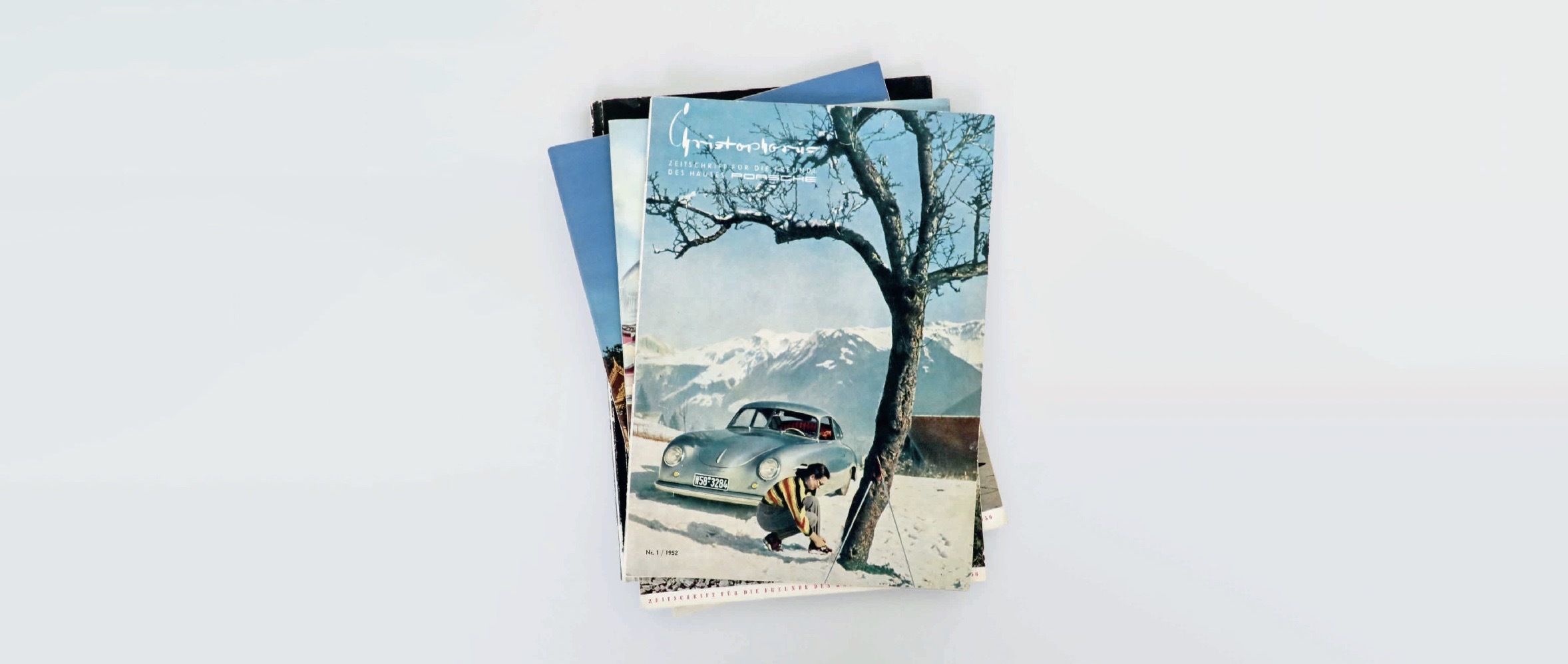
In 1952, four years after the first car bearing the Porsche name received its operating permit, the company published the inaugural issue of Christophorus. The magazine was conceived by Richard von Frankenberg, head of the young press and publicity department in Zuffenhausen, and designed by graphic artist Erich Strenger. Von Frankenberg, who was simultaneously building the Porsche corporate archive and writing the early company history, proposed the name Christophorus after Saint Christopher, the patron saint of travellers and a recurring motif in European driving culture.
The first edition combined motorsport reportage, technical explanation, and travel writing. The print run was small and circulated primarily to owners and dealers, but the editorial ambition was higher than the format of a typical customer mailing. Von Frankenberg wrote with the assumption that the reader was both a Porsche owner and a literate enthusiast, an editorial choice that distinguished the publication from the dealer bulletins of the period.
Erich Strenger's design system
Strenger met von Frankenberg in a Stuttgart cinema in 1950 and began working with Porsche shortly after. By the time Christophorus launched, Strenger had also become the lead designer of Porsche's racing posters and brand graphics. His editorial design favoured measured typography and photographic essays over advertising visuals, an approach that established Porsche communication as something closer to an editorial title than a corporate brochure.
Strenger applied a consistent visual hierarchy across cover and interior pages, with restrained use of colour and a typographic discipline that paralleled his racing poster work. Each issue carried the magazine's name in a hand-drawn lettering that became one of the brand's recognisable typographic signatures. The visual continuity between Strenger's posters and the magazine produced an integrated brand world long before such cross-platform discipline became standard in automotive marketing.
The editorial template
The magazine's editorial template treated the brand voice as a long-form discipline. Articles ranged from motorsport reports written by von Frankenberg, who was himself a successful Porsche racing driver, to travel essays describing routes through the Alps and the south of France. Technical features explained engineering decisions in terms accessible to the general reader, drawing on Porsche's racing programme as a source of editorial material rather than as a separate communication channel.
The title was published consecutively from issue 1 onward, with each edition numbered sequentially regardless of year. By the early 1960s, Christophorus had become a reference for owners and a documentary record of Porsche history, accumulating a back catalogue that the company subsequently used as a primary source for its anniversary publications. Each issue functioned as both contemporary brand communication and an archival entry that would inform future Porsche storytelling.
The magazine as a brand instrument
For Porsche, Christophorus served a function that few automotive brands had attempted. The publication operated as a long-term brand asset that did not depend on advertising performance or sales targets to justify its existence. Its readership was self-selected and engaged, and its editorial integrity allowed Porsche to develop a brand voice that subsequent product launches and racing communications could rely upon. The magazine became part of the ownership experience, alongside the car itself, the dealer relationship, and the racing programme.
The decision to invest in editorial-quality content from the early 1950s shaped the broader Porsche communication infrastructure. The discipline of producing a quarterly publication required the company to maintain a permanent press team, archive systems, and photographic documentation, all of which became standard institutional capacities. By the 1970s, Porsche had built one of the most developed corporate archives in the European automotive industry, much of it traceable to the early Christophorus operation.
Long-term continuity
The magazine continued to appear without interruption through the second half of the 20th century and into the 21st. By the 2010s, Christophorus distributed approximately 100 pages four times a year in eleven languages, including German, English, French, Italian, Spanish, Portuguese, Russian, Chinese, Japanese, Polish, and Korean. The print version continued in parallel with a digital edition that hosted longer-form articles, video content, and the magazine's archive.
The Christophorus model influenced subsequent customer magazines across the automotive industry. Mercedes-Benz, BMW, and Ferrari all developed editorial publications during the second half of the 20th century, each inheriting elements of the format that von Frankenberg and Strenger had established. None matched the continuous numbering and the editorial range of the original Porsche title, which by 2024 had passed issue 410, an editorial achievement that few corporate publications in any industry have sustained.
The launch of Christophorus in 1952 stands as an early example of branded content as a strategic discipline. It treated the customer as a reader rather than a target, and it produced a publication that has outlived most of the marketing campaigns that surrounded it.
Written with AI assistance, edited by a human. Find out more about our Use of AI.