
A survey that names a deadline
ASICS publishes the second edition of its global State of Mind Study in April 2024 under a headline about teenagers: "ASICS GLOBAL STUDY SHOWS LINK BETWEEN REGULAR EXERCISE IN TEENAGE YEARS AND POSITIVE MENTAL WELLBEING IN ADULTHOOD".1 Tomoko Koda, Managing Executive Officer at ASICS, refers to it in the release as "our second global State of Mind Study".1
The fieldwork runs from 17 November to 21 December 2023, covering more than 26,000 respondents across 22 markets, with each market sample nationally representative by age and gender. Professor Brendon Stubbs of King's College London leads it.1 The markets are Australia, Brazil, Canada, Chile, China, Colombia, France, Germany, India, Italy, Japan, Malaysia, the Netherlands, Saudi Arabia, Singapore, South Africa, Spain, Sweden, Thailand, the United Arab Emirates, the United Kingdom and the United States.2
The index is a score out of 100, built from ten traits scored out of ten each. Six are emotional: positive, confident, content, composed, resilient, relaxed. Four are cognitive: focused, calm, alert, energised.2
The finding the release is built on
The study identifies ages 15 to 17 as the window in which lifelong exercise habits are set. People active at that age score higher in adulthood than those who were not, and people who stopped exercising before 15 are reported as 11 per cent less focused, 10 per cent less confident, 10 per cent less calm and 10 per cent less composed.2
The two ASICS sources give different numbers for the same comparison. The press release states that people active at 15 to 17 score 64 out of 100 in adulthood against 61 for inactive peers; the company's own study page gives 66 against 61.1, 2 The discrepancy is ASICS' own and is not reconciled on either page.
Stubbs frames it as a warning: "It is worrying to see this decline in activity levels from younger respondents at such a critical age, particularly as the study uncovered an association with lower wellbeing in adulthood".1
The generational numbers
Gen Z scores 62 out of 100. Baby Boomers score 68 and the Silent Generation 70. Only 19 per cent of Gen Z respondents were active daily in childhood against 57 per cent of the Silent Generation, and 55 per cent of Gen Z exercised several times weekly in youth against 82 per cent of the oldest cohort.2
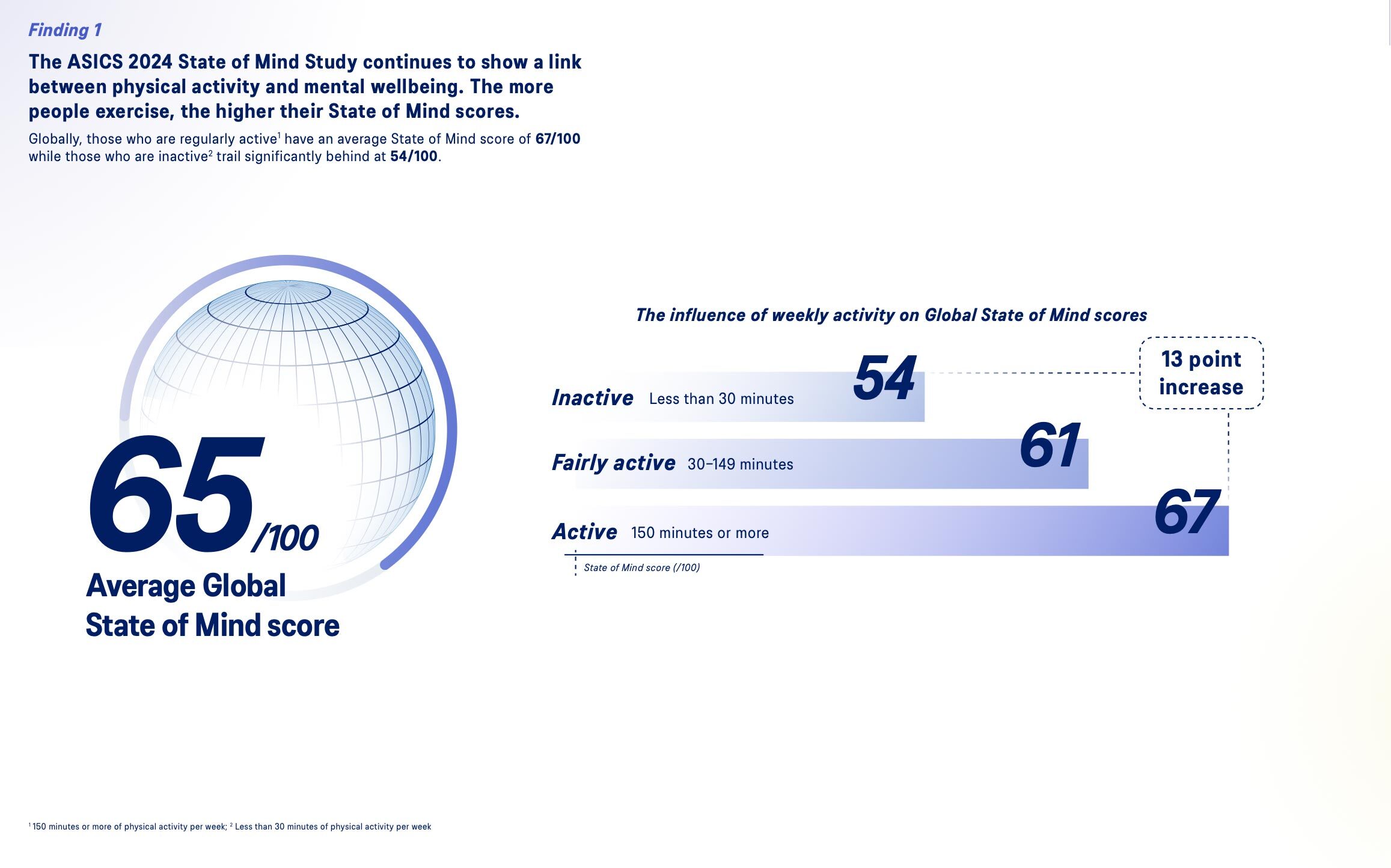
The baseline holds across the whole sample: respondents active for 150 minutes a week or more score 67 out of 100, those doing under 30 minutes score 54.1
Two further splits sit on the study page without a release of their own. Men average 180 minutes of exercise a week and score 68; women average 160 minutes and score 62, with the widest gap of ten points in the United States. By country, China leads at 78, Saudi Arabia is second at 73, and Japan comes last of the 22 at 52.2
The study page also restates the threshold the company has used since its first edition: it takes fifteen minutes and nine seconds of movement to begin to achieve a mental uplift.2
The second edition is larger than the first in markets and smaller in sample. The 2022 edition surveys 37,000 respondents across 16 countries and reports active people at 68 out of 100 against 56 for inactive ones.3 The 2024 edition covers 22 markets with more than 26,000 respondents and reports 67 against 54 on the same comparison.1 The gap between active and inactive respondents holds at twelve to thirteen points across both.

What the index is used for
Koda states the connection to the company in the release: "ASICS was founded on the belief that sport and exercise benefit not only the body, but also the mind."1
The same 2023 fieldwork supplies the desk-based findings behind the Desk Break campaign of September 2024, in which ASICS publishes an employment contract clause for a fifteen minute movement break.4 One survey therefore produces two separate pieces of communication five months apart, the first about teenagers and the second about office workers.
The same ten trait index is applied to each population the company compares. ASICS publishes the trait list and the fieldwork dates alongside the results.2
The 2024 edition adds a date to the argument. Two years after the first edition set a minimum dose, the second sets an age at which the habit is formed, and the window it names runs from 15 to 17.
Written with AI assistance, edited by a human. Find out more about our Use of AI.
1. ASICS Corporation, "ASICS Global Study Shows Link Between Regular Exercise in Teenage Years and Positive Mental Wellbeing in Adulthood", 9 April 2024 on the corporate site and distributed 8 April 2024, for the quoted headline, the fieldwork dates of 17 November to 21 December 2023, the sample of more than 26,000 respondents across 22 markets, the nationally representative sampling, Professor Brendon Stubbs of King's College London as lead, the 150 minute and 30 minute baseline scores of 67 and 54, the 64 against 61 comparison for teenage activity, and the quotations from Professor Stubbs and from Tomoko Koda, Managing Executive Officer at ASICS. https://corp.asics.com/en/press/article/asics-global-study-shows-link-between-regular-exercise-in-teenage-years-and-positive-mental-wellbeing-in-adulthood-
2. ASICS, Global State of Mind 2024 study page, for the full list of 22 markets, the ten traits split into six emotional and four cognitive, the 66 against 61 comparison for teenage activity, the effects reported for those who stopped exercising before 15, the generational scores of 62 for Gen Z, 68 for Baby Boomers and 70 for the Silent Generation, the childhood activity figures, the gender split of 180 against 160 minutes and 68 against 62 points with a ten point gap in the United States, and the country rankings with China first at 78, Saudi Arabia second at 73 and Japan last at 52, and the restated threshold of fifteen minutes and nine seconds. https://www.asics.com/ca/en-ca/global-state-of-mind-2024
3. ASICS Corporation, "ASICS State of Mind Index proves positive impact of movement on world's mental health", 13 April 2022, for the first edition covering 37,000 respondents across 16 countries and for the scores of 68 out of 100 for active people against 56 for inactive people. https://corp.asics.com/en/press/article/asics-state-of-mind-index-proves-positive-impact-of-movement-on-world's-mental-health
4. ASICS, "ASICS PUBLIC SERVICE ANNOUNCEMENT WARNS THE WORLD ABOUT WORKPLACE MENTAL HEALTH THREAT", EMEA newsroom, 24 September 2024, for the reuse of the same 2023 State of Mind fieldwork in the desk-based findings behind the Desk Break campaign and its employment contract clause. https://news-emea.asics.com/latest-news/asics-public-service-announcement-warns-the-world-about-workplace-mental-health-threat/s/cd21911b-0363-49fe-b677-7ab4b567a894