Golden Circle
Quick Facts
Year Introduced: 2011
Complexity: Low
Best For: Purpose-driven brands, founders, internal alignment
How the Golden Circle Works
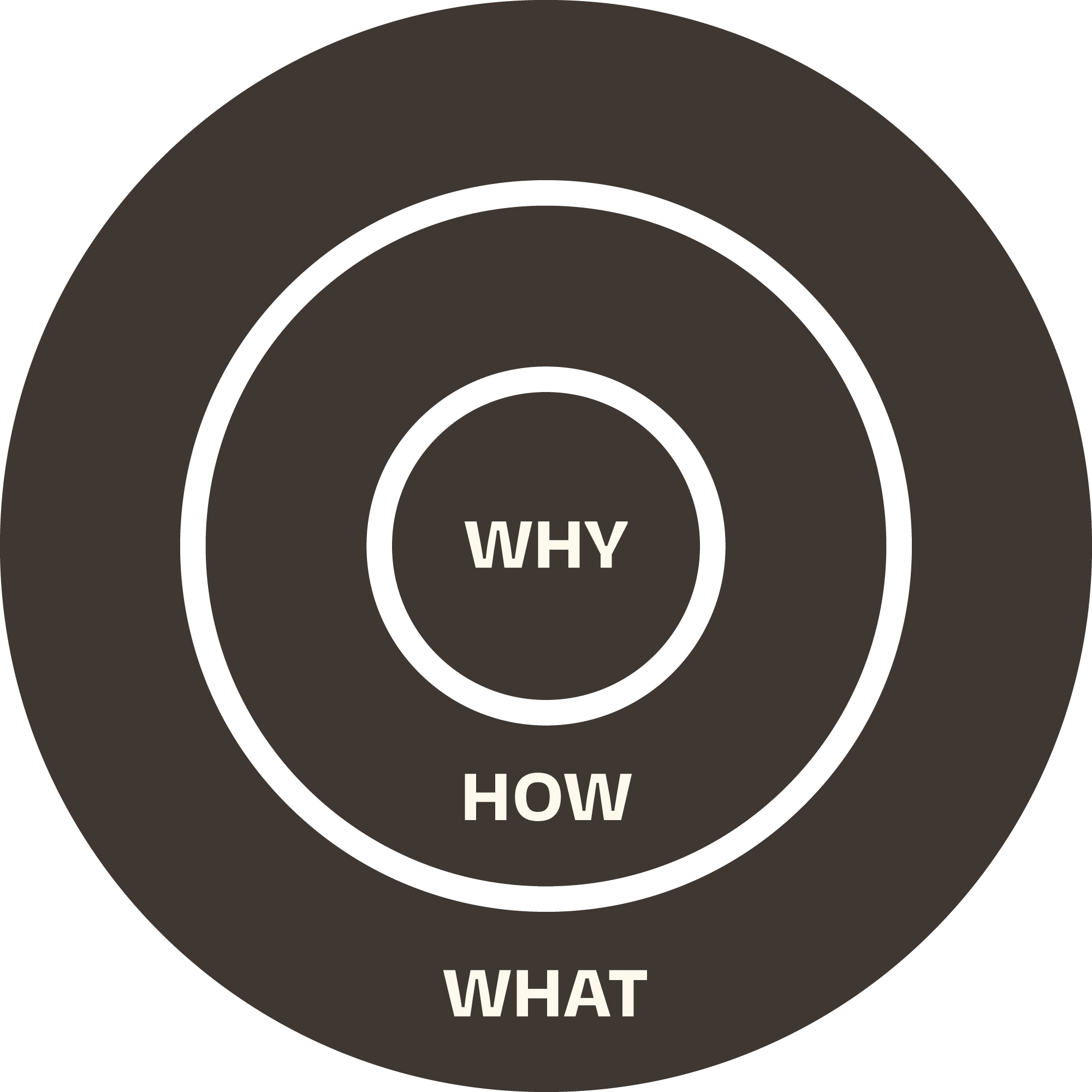
The Golden Circle is one of the simplest and most widely recognized positioning frameworks in modern brand strategy. Developed by Simon Sinek and popularized through his book Start with Why (2009), it proposes that the most inspiring organizations communicate from the inside out: starting with why they exist, before explaining how they do it and what they offer ¹. The model consists of three concentric layers.

Why
The core. Why does this organization exist beyond making money? What is the driving belief or purpose behind everything it does? Sinek argues that most companies can articulate their what easily, but very few can clearly express their why. The ones that can are the ones that inspire loyalty, attract talent, and build lasting brands ¹. In contemporary brand strategy, the Why is essentially what most frameworks now call Purpose.

How
The middle layer. How does the organization bring its purpose to life? This includes the values that guide decisions, the culture that shapes behavior, and the core competencies that differentiate the brand from its competitors ¹. The How is where belief becomes action.

What
The outer layer. What does the company actually do? What products or services does it sell? This is the most tangible and visible part of any business, yet Sinek's central argument is that leading with What is the least effective way to build a meaningful brand ². Most companies communicate outside in. The inspiring ones do the opposite.
The Marketplace Extension
In a later refinement, Sinek added a fourth dimension: the Marketplace. It represents all external stakeholders, customers, partners, competitors, operating in an unstructured system around the organization ³. The key insight: the market only interacts with the What layer. Everything a brand says and does at the What level must therefore clearly reflect its Why. If it doesn't, the ability to inspire breaks down.
Strengths and Limitations
What makes it powerful
The Golden Circle's greatest strength is its radical simplicity. Where many positioning models require weeks of workshops and dozens of parameters, the Golden Circle asks three questions ¹. That makes it exceptionally useful as a starting point: for founders articulating their brand for the first time, for teams that need alignment before diving into more complex frameworks, and for communication strategies that need a clear narrative spine. It is also one of the few models that explicitly prioritizes emotional resonance over functional differentiation. Brands that internalize the Golden Circle tend to build cultures, not just campaigns ².
Where it falls short
The model's simplicity is also its limitation. It does not account for market dynamics, competitive positioning, or target audience segmentation ³. There is no mechanism to incorporate consumer insights, industry trends, or the kind of external forces that shape how a brand must adapt over time. The Golden Circle is purely inside-out. It defines what a brand believes, but not how that belief connects to what the market actually needs ⁴. For brands operating in complex, fast-moving categories, it works best as a philosophical foundation rather than a complete positioning tool.
Source: mentorwithmahdi Youtube
The Golden Circle in Practice
Apple is Sinek's most cited example, and for good reason ¹. Apple's communication has historically led with a belief ("Think Different," challenging the status quo) before explaining how their products deliver on that belief (intuitive design, seamless ecosystems) and only then presenting the product itself. The Why came first. The Mac, iPhone, and iPad were expressions of it, not the other way around.
Patagonia operates with a Why that transcends its product category entirely: the company exists to protect the planet. Every business decision, from supply chain transparency to its "Don't Buy This Jacket" campaign, flows from that core belief. The How (sustainable materials, activism, radical transparency) and the What (outdoor apparel) are downstream consequences.
Tesla entered the automotive industry not by talking about electric motors and battery range, but by declaring a mission to accelerate the world's transition to sustainable energy ². The Why attracted believers long before the product was accessible to the mass market.
¹ Sinek, S. (2009). Start with Why: How Great Leaders Inspire Everyone to Take Action. Portfolio/Penguin. ISBN 978-1-59184-280-4
² Sinek, S. (2009). TED Talk: "How Great Leaders Inspire Action." ted.com/talks/simon_sinek_how_great_leaders_inspire_action
³ Brand Holosphere (2018). "Golden Circle Simon Sinek." brandholosphere.com/golden-circle-simon-sinek
⁴ Wikipedia (2025). "Start with Why." en.wikipedia.org/wiki/Start_with_Why
⁵ Sinek, S., Mead, D. & Docker, P. (2017). Find Your Why: A Practical Guide for Discovering Purpose. Portfolio/Penguin.