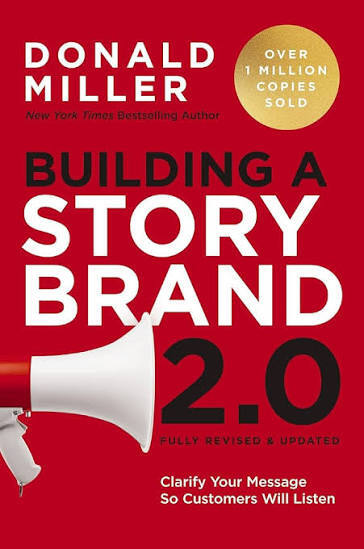
Quick Facts
Review and key takeaways
Review
The premise of Building a StoryBrand is a single, useful inversion. Most brands talk about themselves. They lead with their own history, their own values, their own product features, and assume the customer will care. Donald Miller argues that this is backwards. In every story that works, the protagonist is not the most capable figure in the room. The hero has a problem and is searching for a way through it. The figure who actually changes the outcome is the guide: the mentor who understands the hero, hands over a plan, and helps them win. Miller's central claim is that a brand should never cast itself as the hero of its own marketing. Its job is to be the guide in the customer's story.
That reframing is the heart of the book, and it is the reason it has stayed relevant since the original 2017 edition. It moves the question a brand asks from "how do we describe ourselves?" to "what problem of the customer can we solve, and how do we say it so they understand it instantly?" For anyone who has watched a company drown its message in self-description, this shift alone justifies the read.
The mechanism Miller builds around it is the StoryBrand framework, a seven-part structure drawn from classic narrative theory. A character with a problem meets a guide, who gives them a plan and calls them to action, which helps them avoid failure and ends in success. The framework is deliberately simple, and that is the point. It is built to be applied to a website, an elevator pitch, or a campaign the same afternoon you learn it, rather than to sit in a strategy deck.
Where the book is strongest is in its insistence on clarity over cleverness. Miller's recurring argument is that confused customers do not buy, and that a message exists to be understood, not admired. The framework forces a brand to name the customer's problem before naming its own solution, and to express the result in language a stranger could repeat. This is practical communication discipline, and it is where the book earns its place.
The 2.0 edition keeps that core intact and updates the surrounding material. It adds new examples that reflect a noisier, more distracted media environment, a reworked step-by-step guide to executing a marketing campaign, and access to StoryBrand.ai, a tool trained on Miller's framework that drafts on-brand messaging. The revisions make the book more current and more operational, though the underlying idea is unchanged from the original.
Where it is weaker is in what it does not claim to be. Building a StoryBrand is a framework for messaging, not for positioning. It tells a brand how to talk to its customer once it already knows where it stands, but it offers little help in finding or defending that position in the first place. The competitive landscape, the trade-offs of a strategic stance, the long-term identity questions that foundational positioning theory deals with, all sit outside its scope. Applied mechanically across a whole category, the framework also carries a real risk: if every brand in a sector casts the customer as hero and itself as guide in the same structure, the messages start to converge and sound alike. And like most books in the business-communication genre, it makes its case early and then repeats it, with the practical chapters carrying more weight than the narrative ones.
None of that undermines the book's value. It clarifies the limit of it. Building a StoryBrand 2.0 is a translation tool. It takes a strategic position that already exists and turns it into clear, customer-facing language. Read after the positioning work is done, it is genuinely useful. Read as a substitute for that work, it leaves the hardest question unanswered.
Key takeaways
The customer is the hero, the brand is the guide. The most common mistake in brand communication is making the brand the protagonist. Reverse it. The brand's role is to understand the customer's problem and help them solve it, not to be the centre of the story.
Clarity beats cleverness. Confused customers do not act. A message succeeds when it is understood instantly by someone who knows nothing about the brand, not when it is admired by the people who wrote it.
Lead with the customer's problem, not the product. People engage with a message that names a problem they recognise before it names a solution. Feature lists come later, if at all.
It is a framework for messaging, not for positioning. StoryBrand structures how a brand speaks once it knows what it stands for. It assumes the strategic position is already in place, which is exactly why it works best as a complement to foundational positioning theory rather than a replacement for it.
Who should read this
This book is most useful for founders, marketers, and communicators who have a clear sense of what their brand stands for and need to translate it into language customers actually respond to. It is a working tool for websites, pitches, and campaigns rather than a theory to study. Readers looking for foundational positioning thinking will find it thin on strategy and should pair it with the classics in that field. Treated as applied, supplementary reading, the kind that sharpens execution once the strategic groundwork exists, it delivers exactly what it promises.
About the author