
A flag for the button
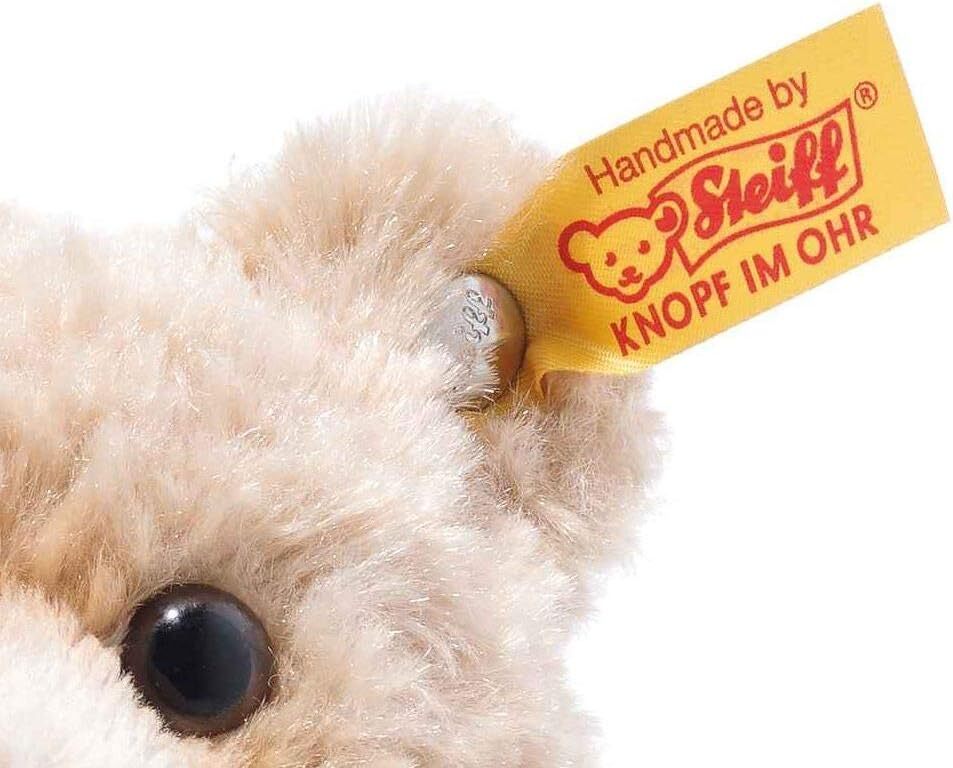
In 1953 Steiff completed the second half of its trademark system. The metal button in the left ear, introduced by Franz Steiff in 1904 and registered at the Imperial Patent Office in 1905, had carried the brand's authenticity signal for nearly half a century. From 1953 onward every animal also wore a small paper tag attached underneath the button. The colour of the tag and the colour of its printing encoded the item's exact position within the Steiff catalogue. The system gave retailers, collectors and gift buyers an immediate visual signal of provenance, scarcity and price tier, written directly on the product.
The code
The 1953 system used three primary configurations. A yellow tag with red lettering identified a regular catalogue item, that is, an animal produced in unrestricted quantities and available through general retail. A white tag with red lettering marked a limited edition, that is, an animal produced in a stated and finite quantity, with a numbered certificate of authenticity. A white tag with black lettering identified a replica, that is, an animal drawn from the Steiff historical archive and produced in a limited run as a recreation of an earlier design. Each tag carried the Steiff wordmark and, for limited editions and replicas, the production number and the year of release.
The colour code was simple enough to be read at retail counter distance, and it was sufficiently distinct to be remembered across the entire Steiff product range. The yellow tag signal in particular became the primary visual identifier of a Steiff animal at retail. Department store buyers used the yellow tag to confirm authenticity at point of receipt. Gift buyers used the colour as a search cue. The system therefore performed both a brand protection function and a category orientation function at the same time.
Why 1953 was the right year
The decision to add a tag system to the existing Knopf im Ohr trademark came at a specific moment in the brand's history. Steiff had spent the late 1940s and the early 1950s recovering from the disruption of the Second World War. The Giengen factories had returned to civilian production in 1947 and had rebuilt the international export network through the early 1950s. The brand was simultaneously preparing for the 1953 fiftieth anniversary of the Bear 55 PB and the registration of the bear design at the Heidenheim District Court, the legal event that had given Steiff its formal trademark protection on the jointed bear.
The fiftieth anniversary year therefore became the occasion for a more formal segmentation of the Steiff catalogue. A commemorative bear known as Jackie, the Jubiläumsbär, was produced for the anniversary in a limited run, and the white tag identifier was introduced to mark Jackie and the subsequent commemorative editions as distinct from the regular catalogue. The yellow tag was introduced in parallel to confirm the standard range. The replica programme followed in subsequent decades and used the white tag with black lettering to identify archive recreations.
The brand consequence
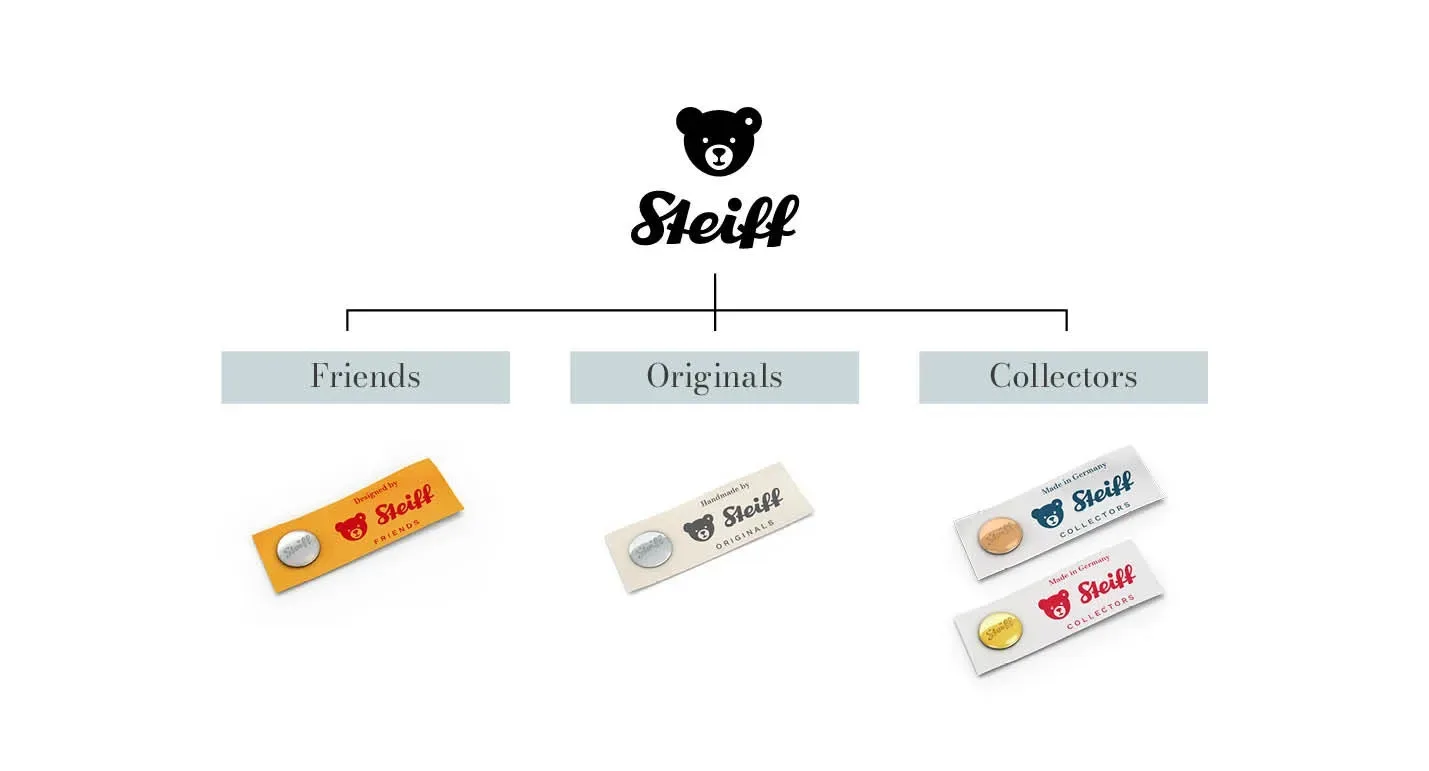
The tag system established a piece of internal brand architecture that the Steiff range continues to use. Three colour configurations resolve to three commercial segments: the standard range for general retail, the limited edition range for collectors, and the replica range for archive enthusiasts. The system made it possible for Steiff to operate three distinct price tiers and three distinct distribution strategies under a single trademark, without confusing the audience at the point of sale.
The arrangement also gave the brand a way to manage scarcity over time. The yellow tag indicated unrestricted availability, which kept the broader audience engaged at accessible price points. The white tag with red lettering created a controlled scarcity that supported the collector pricing, which in turn elevated the perceived value of the standard range. The white tag with black lettering, applied to replicas, gave the brand a mechanism to monetise its own historical archive without diluting either the standard range or the collector range. The result was an internal portfolio structure that the trade typically describes as a price ladder, anchored in a colour code that the audience could read without instruction.
The system today
The 1953 tag system remains in use almost three quarters of a century later. The Steiff e commerce platform and the company's retail partners continue to communicate the tag colour as part of the product description. Collectors continue to use the tag configuration as the primary indicator of provenance when buying on the secondary market. The brand's training material for retail staff continues to use the colour code as the first line of explanation to new customers.
The continuity is itself a piece of brand discipline. Many heritage brands have repeatedly redesigned the visual systems that surround their core trademark in pursuit of contemporary register. Steiff has not. The Knopf im Ohr metal button has retained its 1904 form. The colour tag has retained its 1953 logic. The two together continue to perform the trademark function that they were originally designed for, with no material revision across seven decades. The 1953 tag is therefore not only a brand asset but a working example of a trademark system that has remained legible across generations of buyers.
Written with AI assistance, edited by a human. Find out more about our Use of AI.