
A product becomes a brand through its imagery
Sony released the Walkman TPS-L2 in Japan on 1 July 1979, but the cassette player did not become an internationally recognised brand on the strength of its specification sheet. The transformation took place across the following decade and a half, in print advertisements, television spots, and outdoor posters that taught audiences to read a small blue-and-silver box as a way of moving through the world. By the late 1980s, the Walkman was no longer a Sony product. It was a Sony brand, with its own visual codes, its own audience, and its own cultural authority.
The marketing system that produced this transformation rested on three pillars. The first was a consistent narrative of freedom of movement. The second was a surreal visual signature embodied in the Walkmanhead campaign. The third was a disciplined targeting of youth culture, executed across multiple regional Sony advertising offices working under the corporate Sony marketing division in Tokyo.
Skaters, joggers, and the message of personal mobility
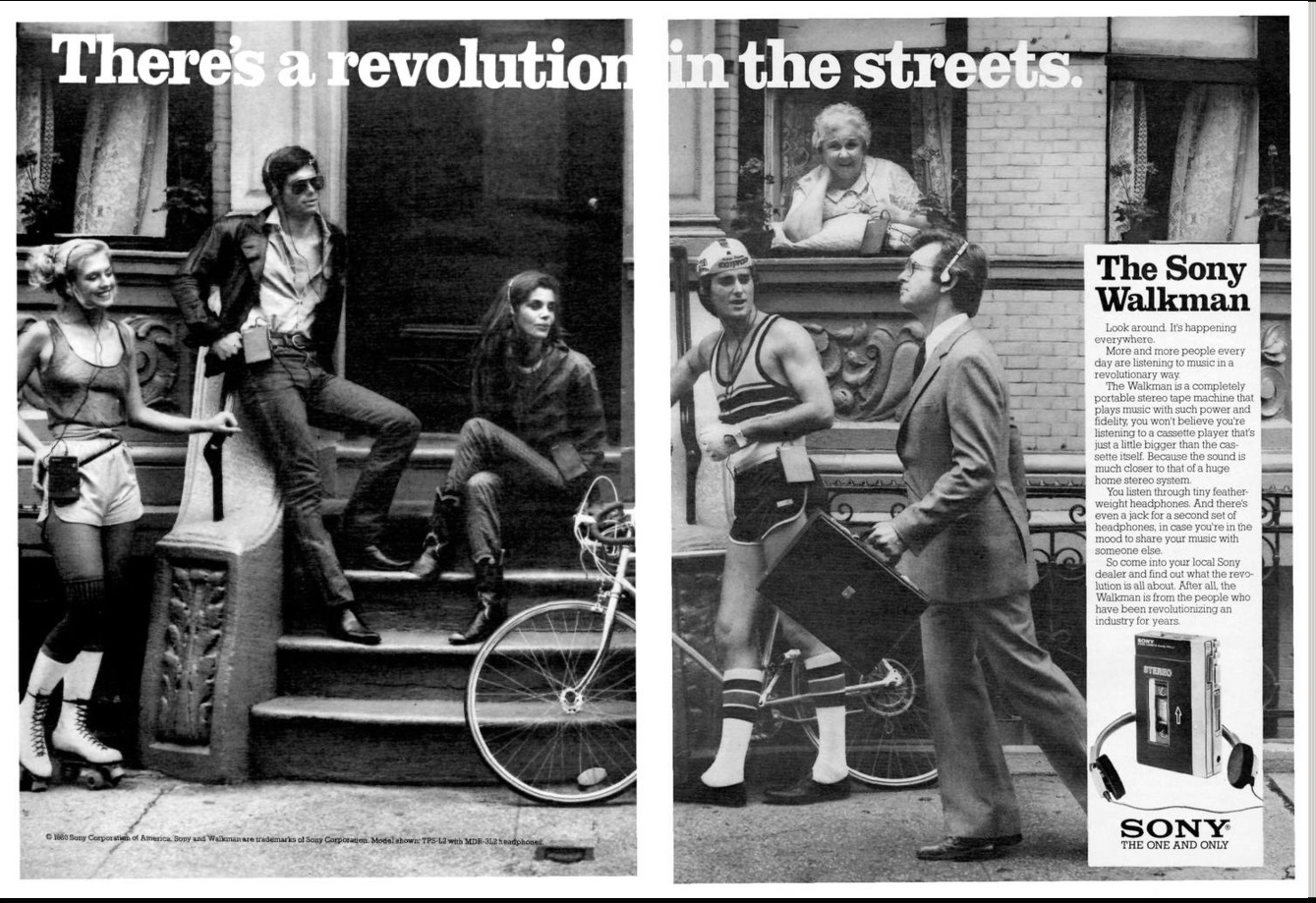
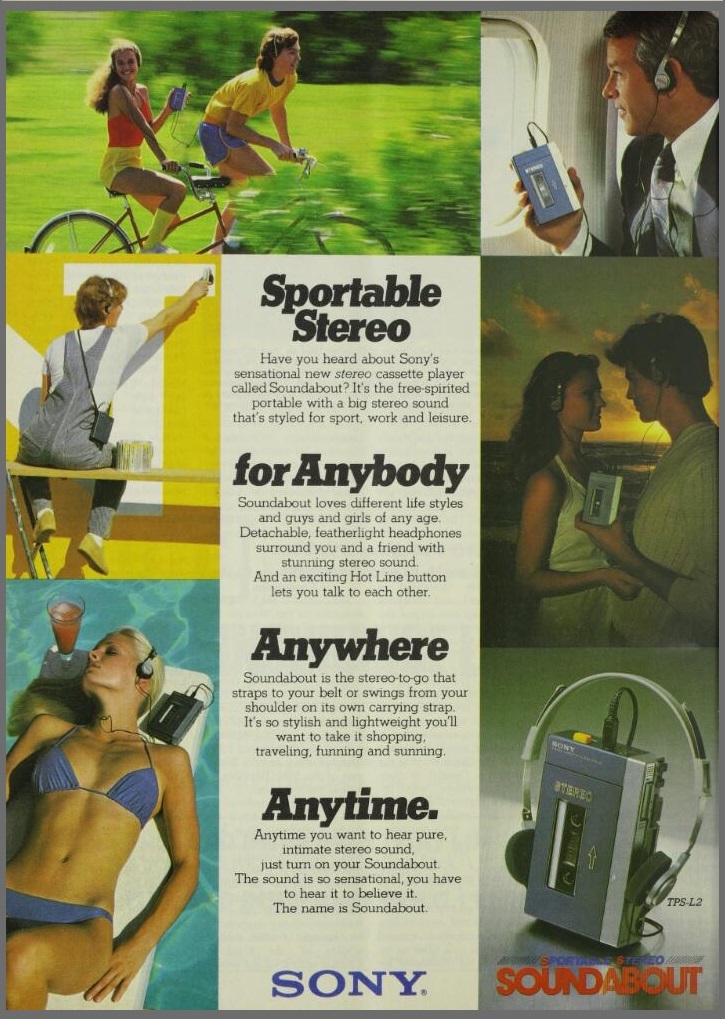
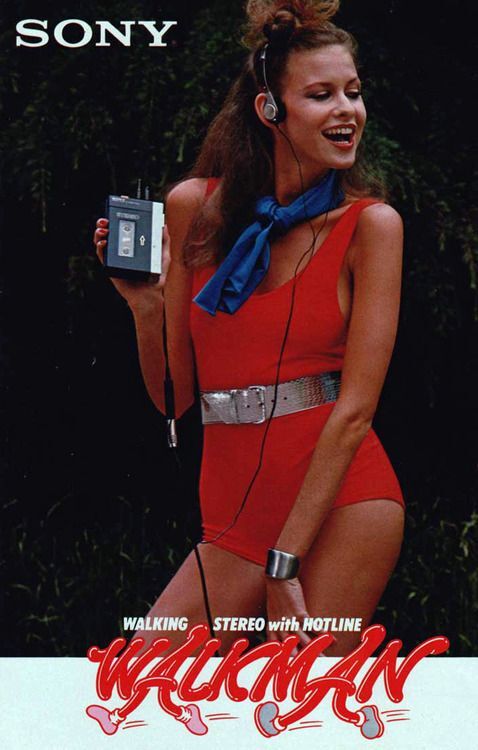
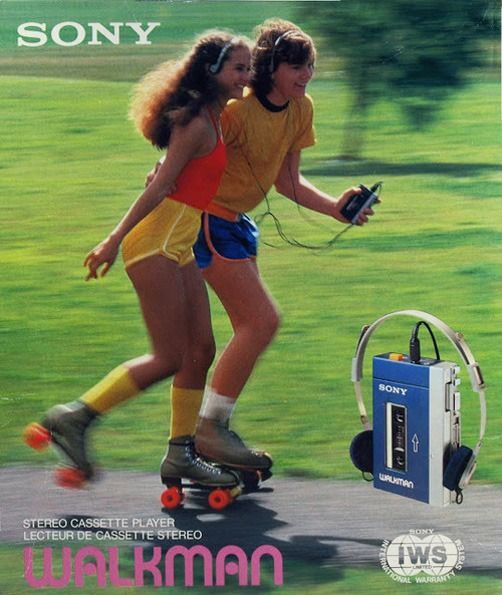
The early 1980s campaigns for the Walkman placed the device on bodies in motion. Print and television advertising routinely featured roller-skating couples, joggers in tracksuits, and young people walking through cities with the small player clipped to a belt and lightweight foam headphones in place. The framing was deliberate. Sony's marketing team in Tokyo and the agencies it briefed in the United States, Europe, and Japan converged on a single proposition: music that travels with you.
The visual repetition mattered. By placing the Walkman on a roller skater on the Californian boardwalk, on a jogger in Hyde Park, and on a teenager on the Tokyo metro, Sony built a vocabulary that was legible across regional contexts without requiring translation. The product itself stayed in the corner of the frame. The lifestyle filled the foreground. The Walkman became readable as the enabler of personal mobility before the cassette mechanism was ever explained.
The Walkmanhead campaign
By the late 1980s, the visual language tightened into something more surreal. The campaign best remembered as Walkmanhead replaced the wearer's head with the cassette player itself. A young woman became a Walkman with a body. A young man became a Walkman with legs. The juxtaposition was deliberately uncanny. By making the device the head of the figure, Sony's creative teams argued that the Walkman was not an accessory worn on the body but a way of seeing and hearing that displaced ordinary perception.
The Walkmanhead executions used flat colour fields and minimal type. They were closer to fashion advertising than to consumer-electronics advertising of the period. The technical specifications of the player were absent. The headphones, the cassette deck, and the play button were the only product cues that survived into the frame. Everything else carried the burden of meaning to the viewer's imagination.
Targeting the next generation
Sony's executive team was explicit about the audience. Internal marketing documents and contemporary trade-press accounts described a strategy of associating the Walkman with youth, activity, sport, leisure, the outdoors, fitness, health, movement, and getting-out-and-about. Teenagers were positioned as the primary target. Sony reasoned that if the product became a possession of choice for fifteen-year-olds in 1985, it would carry forward as a default purchase for those same consumers as they aged into the 1990s.
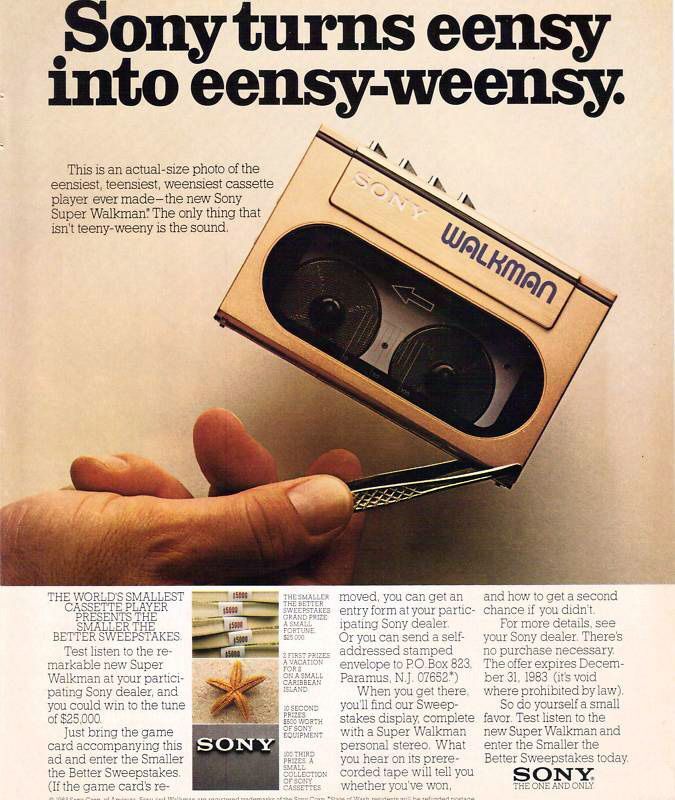
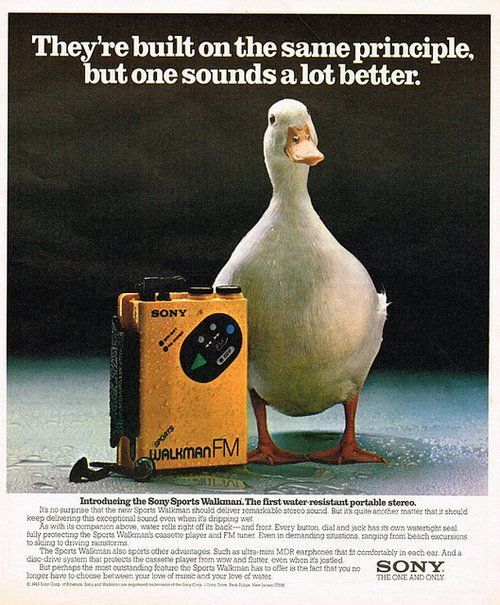
The reasoning held. The Walkman product line ran for more than three decades, with new models cycling through the WM-series in the 1980s, the Sports Walkman with its yellow rubberised housing in the second half of the decade, and the Walkman Professional aimed at journalists and audio engineers. Each new model was launched into the brand vocabulary that the marketing of the early 1980s had already established. Sony did not have to argue for the relevance of each new device, because the Walkman brand had already done that work.
It's a Sony
The Walkman advertising sat under a wider corporate signature. From the late 1970s onward, Sony closed its product communications across categories with the line It's a Sony, a confidence-led claim that turned the manufacturer's name into the proof point. The Walkman benefited from this corporate umbrella but quickly developed an independent visual logic that other Sony product lines did not share. Television advertising for the Trinitron set was rooted in living-room realism. Walkman advertising was rooted in the street, the park, and the surreal Walkmanhead studio.
The split was strategic. Sony's product portfolio was broad enough that no single creative platform could carry it. By letting the Walkman develop its own creative codes, the corporation gave the brand the freedom to speak directly to a younger audience without dragging down the rest of the catalogue. Walkman advertising could be playful, surreal, and fashion-adjacent in a way that television-set advertising could not.
The long shadow of the Walkman brand
The marketing template that Sony built around the Walkman has continued to surface in personal-electronics advertising in the decades since. Apple's silhouette campaign for the iPod in 2003, with its dancing figures against saturated colour backgrounds, drew openly on the Walkman lineage. The lifestyle codes of the Sports Walkman advertising echoed in early 2010s wearables marketing. The decision to sell a portable device on the strength of who carries it rather than what it does was first proven by Sony in the years between 1979 and the late 1990s. The Walkmanhead campaign and its skaters and joggers were the visible expression of that decision.
Source: Evolution Cloud Accounting Youtube
Written with AI assistance, edited by a human. Find out more about our Use of AI.